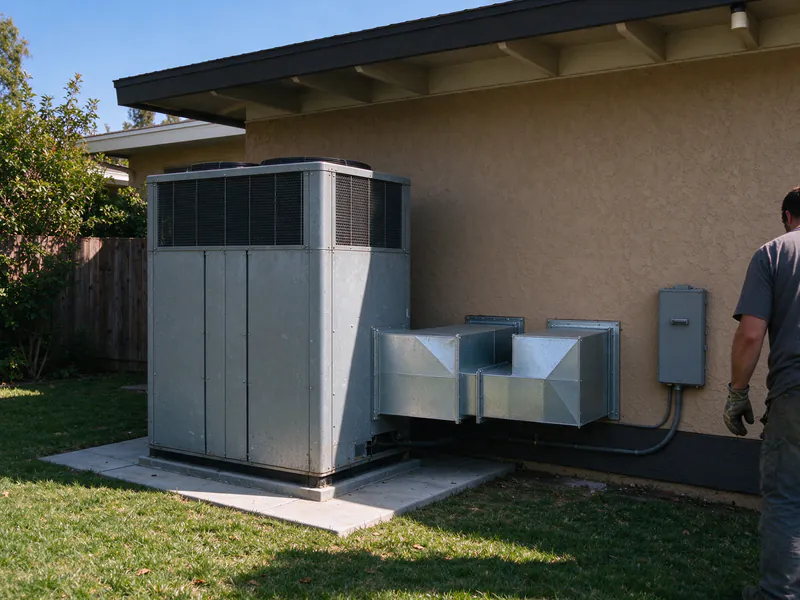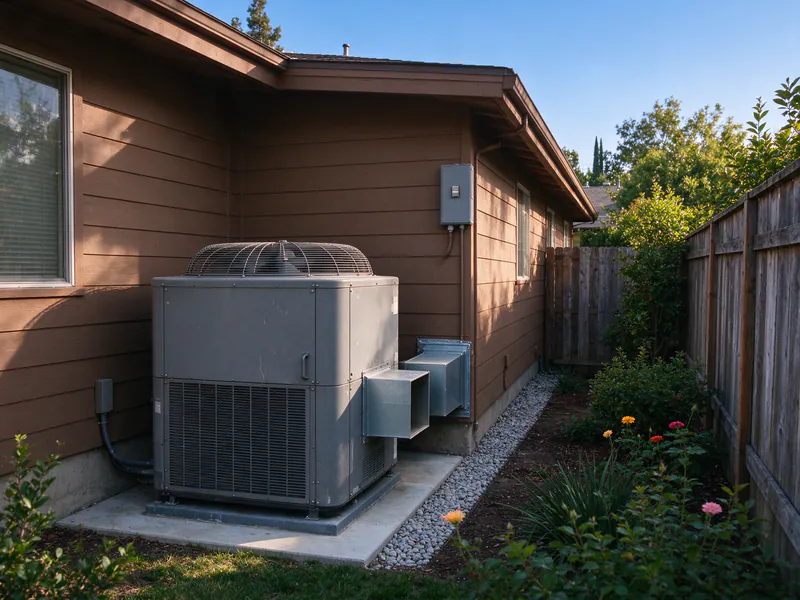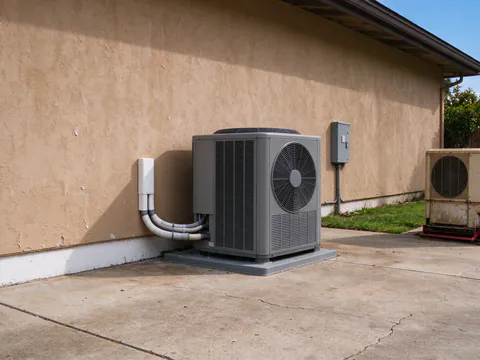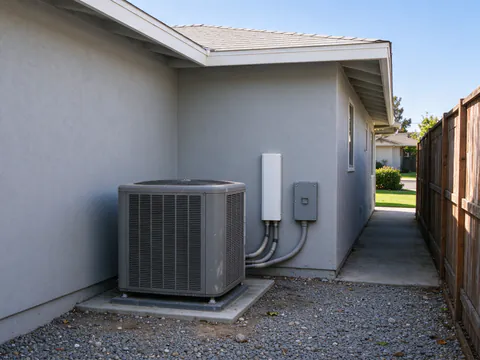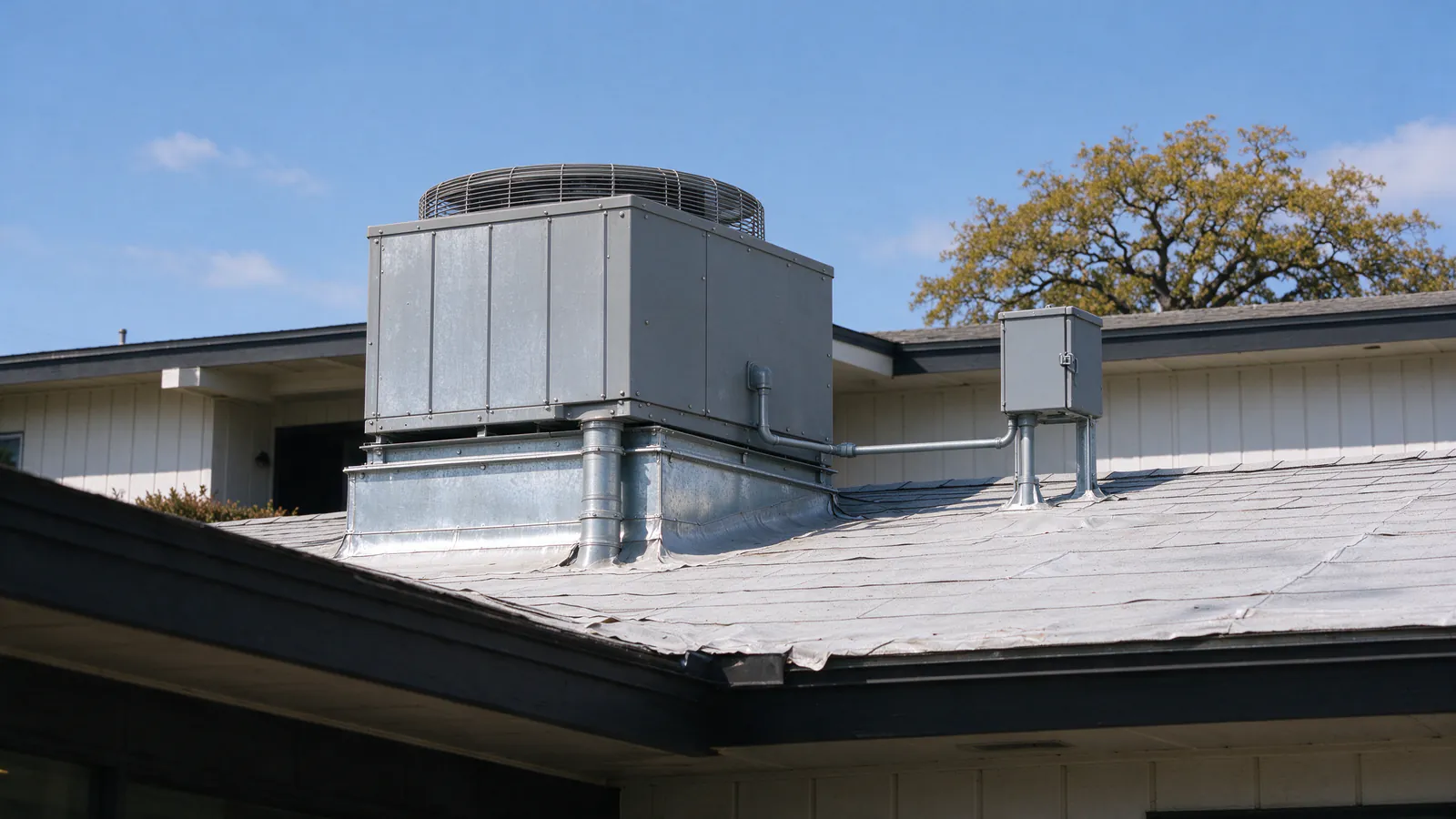
Tule Sacramento Heat Pump replaces package units with package heat pumps on homes across Sacramento County, south Placer County, east Yolo County and El Dorado Hills, with the installation handled by licensed and insured contractors. A package unit holds the whole system in one cabinet, on the roof or on a pad beside the house, with no furnace or air handler inside.
If your heating and cooling come from a single metal box with ducts running straight into the roof or wall, this page is for you. The replacement looks simple from the street, but the curb, the duct connections and the lift decide how simple it really is.
How a package unit differs from a split system
A split system has two halves joined by refrigerant lines: an outdoor unit, and a furnace or air handler indoors. A package unit puts the compressor, both coils and the blower in one factory-sealed cabinet. The ducts connect to it directly.
Gas packs, electric packs and package heat pumps
A gas pack cools with a compressor and heats with gas burners in the same cabinet, fed by a gas line run to the unit. An electric pack heats with resistance strips. A package heat pump uses the same reversing refrigerant cycle as a split heat pump, with electric strips as backup and defrost heat. Replacing either older type with a package heat pump keeps the footprint and ends the gas burner or strip heat as the main source.
Where the ducts meet the cabinet
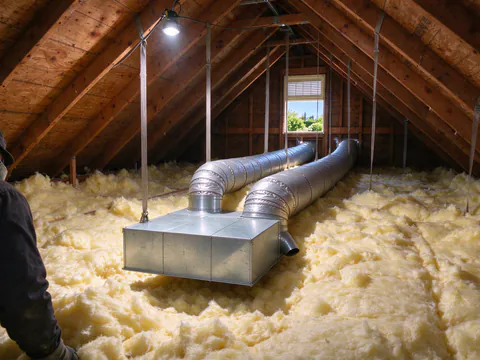
On a roof, the unit sits on a curb with supply and return openings dropping through the roof deck into the attic or ceiling. On the ground, the connections run through a wall into a crawlspace or up into the attic. In either case the transitions between the cabinet and the ducts face the weather, so their sealing and insulation are part of the job.
What happens on the first visit
- The unit. Gas or electric heat, nameplate capacity, age and refrigerant.
- The mounting. Roof or ground, curb or pad dimensions, the roof surface and flashing around the curb.
- The lift. Roof height, the unit’s weight, and how near a crane or rigging point can get.
- The load. A Manual J calculation at local design conditions instead of a copy of the old tonnage.
- The ducts. Connection condition, return size and static pressure.
- The electrical side. Circuit, disconnect and panel capacity for a heat pump with backup strips.
The written scope names the equipment, the lift method, any curb adapter and the permit.
Rooftop or ground: what changes the job
Rooftop units
The old unit comes off and the new one goes up, by crane where weight or reach requires it. When the new cabinet’s base doesn’t match the old curb, a curb adapter bridges the two openings and is sealed to both. The roofing around the curb gets checked while it is exposed.
Roseville’s residential HVAC replacement checklist asks for complete, stamped and signed building plans when a new mechanical unit goes in an attic or on top of an existing roof. A rooftop replacement in Roseville is scoped with that requirement in mind and confirmed with the city per project.
Ground-mounted units
A pad-mounted package unit is simpler to lift but needs level, stable ground and clear airflow around the cabinet. Valley floor stations record essentially no snowfall in NOAA’s normals, so no snow stand is needed; the concern is defrost water, which a heat pump sheds on frosty fog-season mornings and which should drain away from the foundation. The placement and noise guide covers clearances.
Staying package or switching to a split system
The case for staying package
Staying package keeps the ducts where they are and needs no indoor space or line set. A split system needs room for an air handler in an attic, garage or closet, new duct connections to it and a refrigerant line route between the halves.
How the switch affects permits
California’s SB 222, signed September 28, 2026, will streamline heat pump permits for a “swapout,” which it defines as a same-location replacement needing no more than 25 linear feet of new ductwork and not switching between package and split. A change of system type therefore falls outside that definition, and the phase-in runs through 2027 and 2028. For other replacement paths, see heat pump replacement, which covers split systems.
Title 24 testing on a package change-out
California’s compliance manual lists replacing a packaged system as one of the alterations that require the connected ducts to be sealed by the installer and verified by an ECC-Rater. The target is 10% or less total leakage, or 7% or less to the outside; ducts that can’t reach it have every accessible leak sealed and confirmed with a visual and smoke test.
Why rooftop ducts often need sealing
Rooftop transitions and ducts in a hot attic expand and contract through every summer, and joints there can open over time. A sealed, insulated connection keeps cooled air in the house. If testing shows the ducts are beyond sealing, heat pump ductwork covers repair and replacement. The permit and Title 24 guide covers each permit office.
SMUD rebates on package heat pumps
SMUD lists package systems in its heat pump rebate. Replacing a gas pack qualifies for up to $3,000 with a variable-stage system, or $2,000 with a two-stage package system of at least 15.2 SEER2. Replacing an electric pack falls under the $1,000 electric-to-electric tier. Single-stage units are not eligible.
The rebate requires qualifying equipment installed by a participating contractor in the SMUD Contractor Network, a connected Wi-Fi thermostat, permits and a passing Title 24 verification. Rebate-qualified installations are available on request. The SMUD rebate guide lists the terms.
What a package heat pump replacement costs
Package heat pump replacements in the Sacramento area typically run about $15,500 to $24,000 before rebates, with typical jobs near $18,000 to $19,500. SMUD’s own published medians sit in that range: about $19,500 for gas-to-electric package projects and about $19,000 for electric-to-electric. It is a budgeting range, not a quote.
What moves the price
A crane, a curb adapter, roof repair at the curb, electrical work for backup strips and duct sealing that grows into duct replacement each push a job higher. The heat pump replacement cost guide and the installation cost guide explain the components, and the cost estimator gives a range for your house.
Keeping gas in a package unit
Dual fuel package units, with a heat pump and gas burners in one cabinet, exist for owners who want gas backup; dual fuel heat pumps explains how the changeover works. For a full move off gas, gas furnace to heat pump conversion covers the wider project.