A July afternoon
The air conditioner quits
When the AC fails in July, a heat pump can go in its place. It costs more than a like-for-like AC, but it also takes over the heating.
Replacing an AC with a heat pump
3626 Fair Oaks Blvd, Sacramento, CA 95864
Mon-Fri 8am-6pm · Sat-Sun 9am-2pm
One ducted system for tule-fog mornings and 104° design afternoons. We install heat pumps, replace worn ones and convert gas furnaces across the Sacramento region, sized for the hot end of the day.
Why "Tule"? Tule fog is the valley's winter ground fog, named for the tule reeds of the old Sacramento marshes. It is the morning a heat pump heats through, and the 104-degree afternoon is the one it cools through.
31°F
Winter design low
Sacramento airport heating design
41.6°F
January, 7 a.m.
Normal fog-season morning
90.9°F
July, 3 p.m.
Normal summer afternoon
98°F
1% cooling design
The usual sizing point
104°F
Hottest design hour
0.1% design, Sacramento airport
Where most jobs start
A July afternoon
When the AC fails in July, a heat pump can go in its place. It costs more than a like-for-like AC, but it also takes over the heating.
Replacing an AC with a heat pumpBefore winter
A 20-year-old furnace and an AC of the same age are a natural point to switch both to one electric system, and SMUD pays more for gas-to-electric.
Furnace to heat pump conversionAny season
Homes that already heat with electricity are a straight swap, with a choice between two-stage and variable-speed equipment.
Heat pump replacementEvery afternoon
Hot back bedrooms usually trace to attic ducts: leaks, crushed runs or a return too small for the airflow a heat pump needs.
Heat pump ductworkServices
Every job here is a ducted, central system: one outdoor unit and an indoor air handler or furnace coil feeding the ducts you already have, or new ones. Ductless mini splits are a different trade, and this site does not sell them.
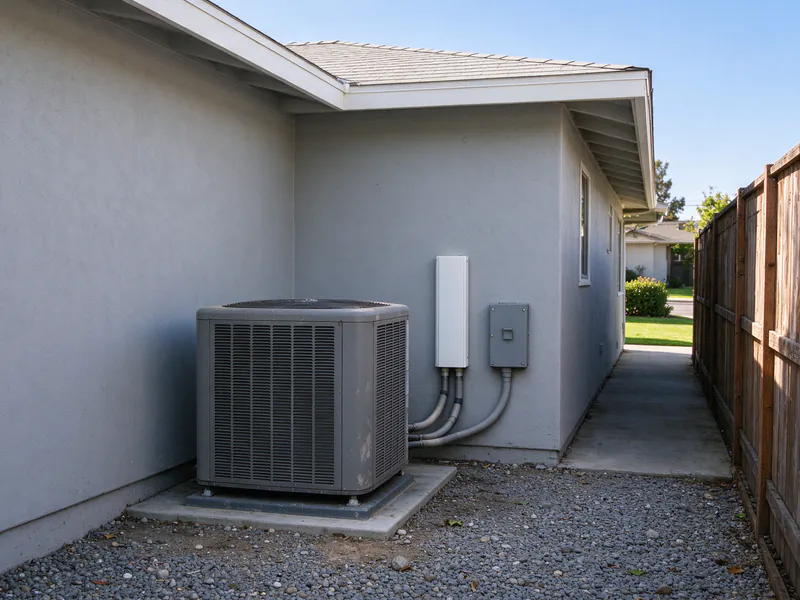
Tule Sacramento Heat Pump converts Sacramento homes from a gas furnace and central AC to one ducted heat pump, which removes the gas heating bill and the separate AC at once.
At SMUD's winter rates a heat pump only has to deliver about 1.4 to 2 units of heat per unit of electricity to beat a 95% gas furnace. Modern equipment does far better than that on a 40-degree morning. In PG&E electric territory the margin is thinner, and the advice changes with it.
The furnace comes out or stays as a cabinet for a new air handler, the AC condenser becomes a heat pump outdoor unit, and the refrigerant lines are replaced or reused if they suit the new refrigerant. The gas line is capped.
The panel. A heat pump with electric backup heat can need a bigger circuit than the AC it replaces, and some older 100-amp panels have no room. If it is short, the upgrade is planned into the job rather than discovered on installation day.
Sizing starts from a load calculation at a 98 to 104 degree afternoon, not the old furnace's label. The permit, Title 24 duct test and refrigerant charge check are part of the job, and SMUD rebate-qualified installs are available on request.
When an existing heat pump wears out, Tule Sacramento Heat Pump replaces it with a system sized for the house as it is today, not as it was when the old one went in. The visit starts with what the old system did badly: rooms that ran hot, noise, or bills that crept up.
If the old unit was simply matched to the tonnage of the AC before it, or the house has since had new windows, attic insulation or a room added, the right size may have changed. An oversized heat pump short-cycles in mild weather and leaves rooms clammy and uneven. A room-by-room load calculation settles it.
Single-stage units run full or off. Two-stage and variable-speed units run slower most of the time: quieter, steadier, and what SMUD's rebate requires. New equipment uses A2L refrigerants, so line-set reuse is checked, not assumed. Variable-speed units also hold temperature better through Sacramento's long, mild spring and fall.
California treats a replacement as an alteration: connected ducts are sealed and tested, and an ECC-Rater verifies leakage and charge. The City of Sacramento issues most like-for-like change-outs as a minor online permit, with the new unit in the old spot and no more than 25% larger.
If your air conditioner has failed, Tule Sacramento Heat Pump can put a heat pump in its place. It is an air conditioner with a reversing valve, so summer cooling is identical and from November to March the same unit heats the house.
Dual fuel: the gas furnace takes over only on the coldest mornings. Suits a newer furnace with years left in it. The furnace and its venting stay, and a matched coil goes on top.
A full conversion: no gas heating at all. Suits an aging furnace, especially in SMUD territory. The furnace is removed or kept as the air handler cabinet, and the gas line is capped.
Which makes sense depends on the furnace's age, your electric utility and how long you plan to stay. In PG&E electric territory, such as West Sacramento, Davis or Rocklin, the heating economics are much tighter than with SMUD.
Either way, the assessment looks at the furnace's age, the coil and the ducts first, because a new heat pump on a tired duct system will not cool the back bedrooms any better than the old AC did.
Even an urgent July swap is matched properly: outdoor unit and coil rated together, charge verified, permit pulled. A heat pump can't simply be hung on an old furnace coil.
More on replacing an AC with a heat pump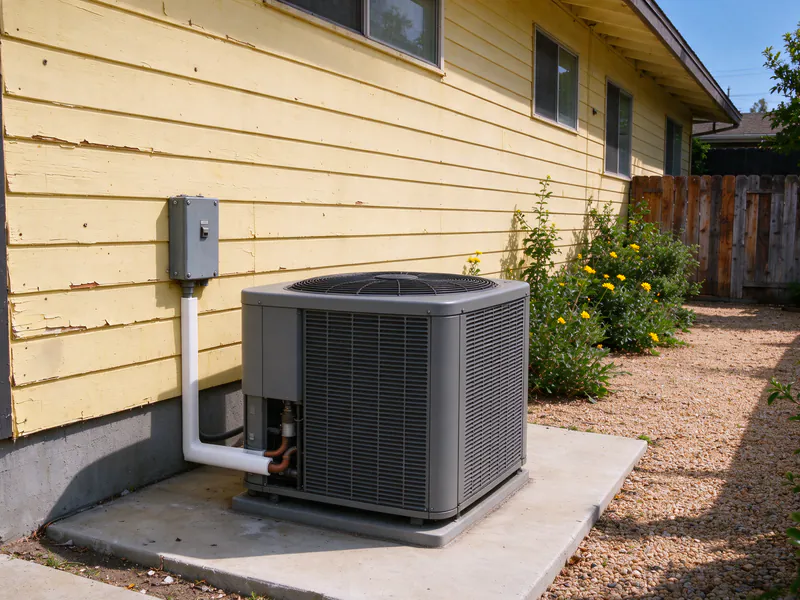
Tule Sacramento Heat Pump installs dual fuel systems for homeowners who want a heat pump without giving up gas heat. The heat pump does all the cooling and most of the heating; the furnace runs only below a changeover point.
That is the main design decision. In SMUD territory winter electricity is cheap enough that the furnace rarely needs to run, so dual fuel is usually about keeping a newer furnace. In PG&E electric territory, with winter rates roughly double, the furnace earns its keep on more mornings.
A heat pump outdoor unit paired with a coil matched to your furnace, thermostat wiring so the two never run against each other, and set lockout temperatures. Combustion safety and venting are checked separately. The thermostat settings are explained at handoff, so the backup doesn't come on by mistake.
The permit and Title 24 duct and refrigerant checks apply as they do to a conversion. SMUD's gas-to-electric rebate is written for replacing gas heat, so eligibility for a dual fuel system is confirmed per job before it is counted in the price.
Dual fuel also suits a house with a large heating load for its size, such as an older home with little wall insulation: the furnace covers the coldest hours while the heat pump stays correctly sized for summer.
More on dual fuel heat pumps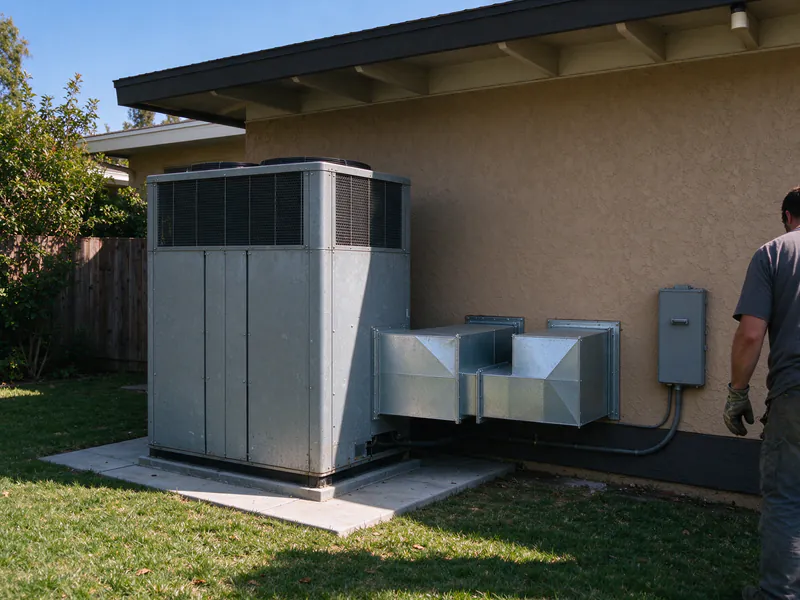
Some Sacramento homes have a package unit: the whole system in one cabinet on the roof or a pad, ducts running straight into the attic or under the floor. Tule Sacramento Heat Pump replaces gas-electric package units with package heat pumps, and old package heat pumps with new ones, so the house goes electric without moving anything indoors.
Ground-mounted units are simpler: the pad is checked for level and drainage, and the new cabinet is set so condensate and defrost water run away from the foundation. Old refrigerant is recovered before the old unit comes out, as federal rules require.
A two-stage package system with at least 15.2 SEER2 is one of the equipment types SMUD's rebate covers, and like any change-out it needs a permit, with the Title 24 duct and refrigerant checks.
A heat pump is only as good as the ducts behind it. Tule Sacramento Heat Pump tests, repairs and replaces attic ductwork as part of heat pump projects across the Sacramento region. Testing comes before the equipment is chosen, because the results can change which system size makes sense.
Ducts that run through an attic sit in air well above the outdoor temperature on a summer afternoon. A leaking or crushed duct pulls hot, dusty air into the system and starves the rooms at the far end of the run.
A furnace heats air past 100 degrees, so a weak duct still feels warm. A heat pump delivers cooler air and needs more of it, so small returns and kinked flex runs show up as rooms that never get comfortable. Static pressure and leakage are measured before equipment is chosen.
New ducts are insulated, and repair versus replacement follows what the test finds, not the ducts' age.
Small fixes, such as resealing boots and the plenum joint or adding a return to a closed-off bedroom, often recover most of the airflow without replacing the whole system. When ducts are replaced in the same project, Sacramento-area conversions typically run about $20,000 to $31,000 before rebates.
More on heat pump ductwork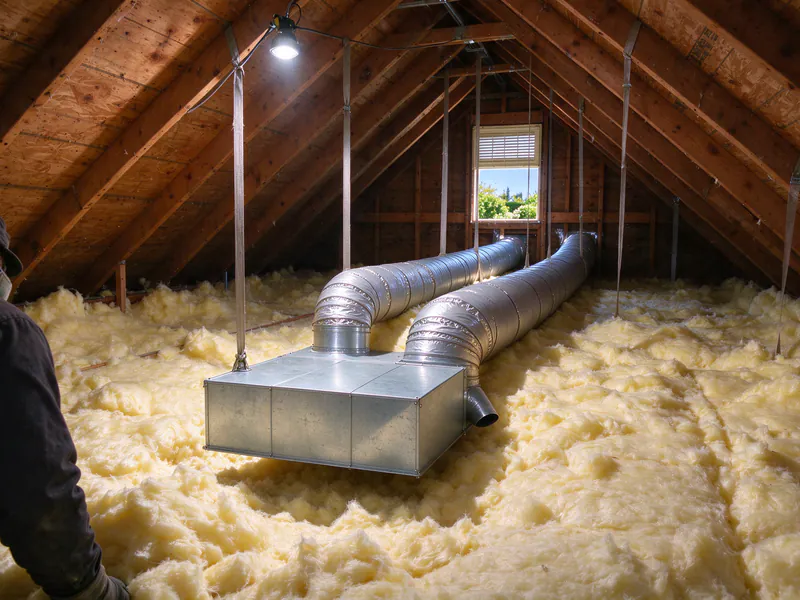
Also:Air handler replacementVariable-speed heat pumpsHeat pumps for older homesCommercial heat pumpsHeat pump repairHeat pump maintenance
How we approach it
Equipment is chosen from a load calculation at the local design temperatures, so the cooling side carries a 98 to 104 degree afternoon without oversizing for winter.
SMUD, Roseville Electric and PG&E price winter electricity very differently. The recommendation between conversion, dual fuel and replacement takes your rate into account.
Published Sacramento-area price ranges and a cost estimator give you a budget before anyone comes out. The work itself is carried out by licensed and insured contractors.
From first call to a running system
First call
What you have now, what isn't working, your utility and what you want the new system to do.
Assessment
A room-by-room load calculation, a look at the ducts and returns, the electrical panel and where the outdoor unit can go.
Installation
Permit pulled, old equipment recovered and removed, new units set, lines brazed, pressure-tested and evacuated before charging.
Handoff
Airflow, charge and backup heat checked, the ECC-Rater visit for Title 24, and the thermostat set up and walked through.
Tell us about the house and the system you have. We'll come back with what the job involves and what it is likely to cost.
Sacramento-area price ranges
Typical ranges for single-family homes in the Sacramento area, before rebates. They are budgeting figures, not a quote; your price depends on what the assessment finds.
$15,000-$24,000typical jobs near $18,000-$19,000
Heat pump, matched air handler or coil, refrigerant lines, permit and Title 24 testing. Panel upgrades and new ducts are extra.
$15,500-$24,000typical jobs near $18,000-$19,500
Roof or pad unit swap with duct transitions and testing. A crane, a curb adapter or electrical work move the price.
$20,000-$31,000ducts replaced in the same project
Everything in a conversion plus a new, insulated duct system sized for heat pump airflow.
Not included above: a panel upgrade from 100 to 200 amps, which typically adds $1,500 to $4,500 in the Sacramento area. SMUD customers may qualify for up to $3,000 on a qualifying gas-to-electric heat pump. Try the heat pump cost estimator or read the full cost guide.
The real choice
| New AC, keep gas furnace | Dual fuel heat pump | All-electric heat pump | |
|---|---|---|---|
| Cooling | Same as a heat pump | Heat pump | Heat pump |
| Heating | Gas furnace | Heat pump most days, furnace on cold mornings | Heat pump, electric backup for rare cold snaps |
| Gas bill | Unchanged | Much lower | No gas heating bill |
| SMUD gas-to-electric rebate | No | Confirmed per job | Yes, on qualifying equipment |
| Suits | A newer furnace and a tight budget | A furnace with years left, or PG&E electric rates | An aging furnace in SMUD territory |
| Check first | Furnace age and coil match | Changeover temperature and controls | Panel capacity and ducts |
Heat pump vs gas furnace in Sacramento goes through the operating costs by utility.
What the guides cover
Each topic below has a full guide; these are the local facts and rules that matter most, so you can see where your project stands before reading further.
3electric utilities in the metro; PG&E supplies the gas
A ducted heat pump is a central air conditioner with a reversing valve, so one outdoor unit cools the house in July and heats it on foggy January mornings.
Around Sacramento, three things decide how that plays out. First, your electric utility: SMUD, Roseville Electric or PG&E, while PG&E supplies gas across the region.
Second, your climate zone: Title 24 puts the Placer County cities in zone 11 and most of the rest of the area in zone 12, with 1% design afternoons from 95°F in Galt to 103°F in Rocklin. Third, the house itself: its ducts, its panel and the permit office that covers the parcel.
The Sacramento homeowner's guide walks through all of it, from how the refrigerant loop works to which rebates are still open.
~$18,950SMUD's published median for gas-to-electric heat pump projects, before rebates
Replacing a gas furnace and central air conditioner with one ducted heat pump has a public benchmark here: SMUD's running median for gas-to-electric heat pump projects in its rebate program is about $18,950 before rebates.
The total moves with what the house needs beyond the equipment. In local program data, conversions without panel or duct work had a lower median, near $16,800, while a 100- to 200-amp panel upgrade typically adds $1,500 to $4,500.
On a qualifying system, SMUD's $3,000 rebate for variable-stage equipment, or $2,000 for two-stage, then comes off the total, and its Go Electric rebates may offset part of the panel and circuit work. Capping the gas line and removing or reusing the furnace cabinet are part of the scope.
The conversion cost breakdown shows where each part of the price goes.
~$17,000SMUD's published median for electric-to-heat-pump upgrades, split systems
If the house already heats with electricity, whether through an older heat pump or electric resistance heat, there is no gas line to cap and no furnace to take out, and SMUD tracks those jobs as a separate category.
Its published median for electric-to-heat-pump upgrades is about $17,000 for split systems and about $19,000 for package units, before rebates. Individual projects run far wider: SMUD's program figures stretch from about $9,000 to nearly $45,000, which is why this site gives a midpoint rather than a band.
What moves a replacement price includes whether the air handler and line set suit the newer A2L refrigerants, whether the ducts pass their test, and the compressor tier. SMUD pays $1,000 on a qualifying two- or variable-stage electric-to-electric upgrade. The replacement cost guide lays out each driver.
R-8minimum insulation on new ducts for SMUD's rebate
SMUD's heat pump rebate is not something a homeowner files alone.
A participating contractor in the SMUD Contractor Network submits it, and may apply it upfront on the invoice. The paperwork follows the code: the job needs its permit and inspections, a passing Title 24 result recorded on the CF3R form, any new ductwork insulated to at least R-8, and a Wi-Fi, seven-day programmable connected thermostat.
The home needs an active SMUD account on its own SMUD meter, single-stage equipment does not qualify, and Efficiency First California may carry out a field quality check afterward. Money is subject to funding, and SMUD says its rebate can be combined with other incentives where any apply. Rebate-qualified installations are available on request.
The SMUD rebate walkthrough covers each requirement and the Go Electric add-ons.
Nov 14, 2025last day to reserve TECH Clean California incentives
Most of the statewide and federal money that once stacked on a heat pump is gone.
TECH Clean California took its last reservations on November 14, 2025. The federal HEEHRA rebates, worth up to $8,000 for income-qualified households, are fully reserved in California, and the Energy Commission says a second phase will be announced later.
The federal 25C tax credit covered qualifying heat pumps placed in service through the end of 2025 and does not apply after that.
Outside SMUD, Roseville Electric lists no residential heat pump rebate and no single-family PG&E heat pump rebate is on record, so a budget in Roseville, Davis or Rocklin should assume no utility rebate. The Energy Commission also warns about scams offering federal heat pump rebates. The statewide incentive guide records each program's status.
14days a year at 100°F or hotter, Sacramento Executive Airport (NOAA normals)
A heat pump cools the same way a central air conditioner does, so the July question is capacity and airflow, not the technology.
NOAA's normals for Sacramento Executive Airport count about 76 days a year at 90°F or hotter and 14 at 100°F or hotter, and the heat is dry: the July mean dew point is about 54°F, so nearly all the load is temperature rather than humidity. That shapes what matters.
Cooling capacity drops as the outdoor air gets hotter, attic ducts pick up heat on the way to the rooms, and SMUD's highest summer price falls on weekdays from 5 to 8 p.m., late in the hot part of the day.
A variable-speed unit that pre-cools and then runs slowly through the evening fits that pattern. The summer performance guide explains rated capacity at high temperatures.
25%largest size increase on the City of Sacramento's standard change-out permit
Capacity should come from a room-by-room load calculation at your town's design conditions, not from the tonnage on the old condenser.
Design afternoons run from 97°F in Davis to 103°F in Rocklin at the 1% level, and new windows, insulation or an addition change the load too. Oversizing has a cost: a system that is too big short-cycles in spring and fall and leaves the far rooms uneven. Title 24 limits it.
Unless airflow is verified at 350 cfm per ton or more, a replacement heat pump may exceed the cooling load by only about 6,000 Btu per hour.
The City of Sacramento's standard web permit also keeps the new unit within 25% of the old one's size; 1,682 of the 1,950 heat pump permits it issued from October 26, 2025 to October 25, 2026 carried that condition. The sizing guide shows how a load is built up.
0.0-0.2nights a year at or below 20°F at Sacramento's airport stations (NOAA normals)
A ducted heat pump's air handler can hold electric heat strips as backup.
On the valley floor they are rarely needed for capacity: NOAA's normals show 0.0 to 0.2 nights a year at or below 20°F at the Sacramento airport stations, and the airport's 0.2% heating design is 31°F.
Where strips earn their place is during a defrost cycle, when the unit briefly runs in cooling mode and the strips keep the supply air from turning cool.
The risk is in the controls: a thermostat that brings the strips on every time the setting jumps a few degrees can push winter bills up without anyone noticing. Title 24 also limits electric resistance as the primary heat in a replacement system, and strips add electrical load that can decide the panel question.
The backup heat and defrost guide explains lockout settings and what an aux heat indicator means.
$0.1285SMUD winter off-peak price per kWh
Switching to a heat pump moves heating onto the electric bill, so the rate plan matters as much as the equipment.
SMUD's standard Time-of-Day rate charges $0.1285 per kWh off-peak in winter and $0.3765 at the weekday 5 to 8 p.m. summer peak, plus a $27 monthly fixed charge.
PG&E's E-ELEC plan, open to homes that use an electric heat pump as their main heating and cooling, charges about 28 to 32 cents per kWh in winter, with its peak from 4 to 9 p.m. every day. Roseville Electric has no residential time-of-use schedule; its second tier starts above 500 kWh a month.
In practice that means pre-cooling before the peak, a setback schedule the heat pump can recover from without strips, and checking whether another plan suits the new load. The electric bill guide runs the numbers by utility.
2.9therms a day used by PG&E-gas, SMUD-electric homes in a peak February week (CEC 2019 survey)
Gas across the region comes from PG&E, at a residential baseline rate near $2.54 per therm, and winter is when that bill peaks: in the Energy Commission's 2019 appliance survey, homes with PG&E gas and SMUD electricity averaged 2.9 therms a day in the coldest February week.
Retiring the furnace removes that heating bill along with the burner, flue and gas valve, and the combustion checks they need. The air feels different too.
A furnace sends air above 100°F in short bursts, while a heat pump sends milder air for longer, which heats the house as well but feels cooler at the register.
The running-cost comparison turns on your electric rate, and on PG&E's default E-TOU-C plan a heat pump has to average a COP of about 4 to beat a 95% furnace. The furnace comparison sets the two side by side.
89%SMUD households with central air conditioning (CEC 2019 survey)
Most homes in SMUD territory already have a duct system: in the Energy Commission's 2019 survey, about 89% of SMUD households had central air conditioning, against 51% in PG&E's territory.
For those houses a ducted heat pump works through the existing ducts, with one indoor air handler or furnace coil and one outdoor unit, so nothing new goes on the walls of each room. Ductless mini splits put a head in each room and suit additions, converted garages or houses that never had ducts.
They are a separate trade and are not offered through this site. For a ducted system, the deciding question is whether the existing ducts can carry heat pump airflow once they have been tested and sealed. The ducted and ductless comparison sets out the comfort, cost and layout tradeoffs.
$200SB 222 permit fee cap for a residential heat pump HVAC system
California treats a heat pump change-out as an alteration, so the permit brings a set of checks with it.
The installer seals the connected ducts and an ECC-Rater tests them against a target of 10% total leakage or 7% leakage to the outside, with a tighter 6% where the system sits in a garage. Refrigerant charge is verified for heat pumps in every climate zone, with at least 300 cfm of airflow per ton.
City of Sacramento change-out inspections also look for working carbon monoxide and smoke alarms.
State law is set to simplify the process: SB 222 caps the permit fee for a residential heat pump HVAC system at $200 unless a city or county adopts written findings, and requires automated online permitting for licensed contractors by July 1, 2028. Ask the permit office whether the cap applies yet.
The permit and Title 24 guide goes office by office.
719City of Sacramento permit descriptions mentioning a panel, Jan 1 to Oct 25, 2026
Whether a heat pump needs electrical work depends on its backup heat and on what the panel already carries.
The City of Davis's service-load worksheet counts a heat pump's nameplate load in full, which shows how quickly a heat pump and an EV charger can fill an older 100-amp service.
City of Sacramento permits show how often the two kinds of work travel together: 719 permit descriptions from January 1 to October 25, 2026 mention a main service panel or a panel upgrade. Two SMUD details are worth knowing before an upgrade.
Go Electric pays toward a panel, subpanel or new circuits only on gas-to-electric projects, and SMUD's Low Use rate, with its lower fixed charge, is limited to panels of 125 amps or smaller and low monthly use. A panel upgrade also takes its own electrical permit.
The panel and circuit guide covers load calculations and costs.
2045City of Sacramento goal for all-electric existing buildings
Nothing the City of Sacramento has adopted requires an existing home to replace a working gas furnace.
Its Existing Building Electrification Strategy, adopted in May 2024, sets a goal of all-electric existing buildings by 2045, and the City's own FAQ says it will not set mandatory requirements for immediate appliance replacement.
The state's heat pump baseline in Title 24 applies to new construction, where homes are designed around heat pumps and a gas furnace is possible only through the code's performance path. State law also pushes the other way for existing homes: SB 222 voids HOA rules that would block a gas-to-electric replacement.
In practice the furnace's age and your electric utility, not a deadline, set the timing for most households. The guide to California's gas furnace rules tracks which rules are adopted and which are only proposals.
10%SMUD households with a heat pump in the CEC's 2019 survey
A heat pump and a central air conditioner cool identically; the heat pump adds a reversing valve so the same outdoor unit can also heat.
That makes the comparison mostly about winter and money. In the Energy Commission's 2019 survey about 10% of SMUD households had a heat pump, against 89% with central air, so for many homes the AC replacement is the first chance to make the switch.
A new AC leaves the gas furnace doing all the heating and earns no SMUD heat pump rebate. A heat pump costs more than a like-for-like AC but takes over most or all of the heating, and at SMUD's winter rates it can heat for less than gas at modest efficiency.
Either way the outdoor unit needs a matched indoor coil, a permit and Title 24 testing. The AC comparison guide compares the two over the life of the system.
13%SMUD households with an evaporative cooler (CEC 2019 survey)
Evaporative coolers work in Sacramento because summer air is dry: the July mean dew point at the airport is about 54°F, and about 13% of SMUD households had one in the Energy Commission's 2019 survey.
Their limit is physics. A cooler cannot bring air below the outdoor wet-bulb temperature, which is 70°F on a 98°F design afternoon in the CEC's data, so its supply air stays well above what a refrigerated system delivers. It also cools by pulling outdoor air through wet pads, which brings wildfire smoke in with it.
A heat pump recirculates and filters indoor air and heats in winter. The catch is ducts: if the cooler feeds a single ceiling outlet or its own duct, the heat pump needs ducts sized for its airflow, so the existing furnace ducts or new ones set the scope. The evaporative cooler comparison covers the switch.
15.2minimum SEER2 for SMUD's two-stage rebate
SEER2 rates seasonal cooling efficiency and HSPF2 rates seasonal heating efficiency.
Both are measured on a matched outdoor and indoor pair, so a rating only holds when the coil or air handler is the one it was tested with.
Sacramento sizes for the summer afternoon, but the heating season is long: NOAA's normals give Sacramento Executive Airport about 2,436 heating degree days a year against 1,292 cooling degree days. HSPF2 therefore deserves as much attention as SEER2 here, especially in SMUD territory, where winter heating is where the savings over gas come from.
SMUD's rebate sets the floor at 15.2 SEER2 with a two-stage or variable-stage compressor. Ratings also assume correct charge and airflow, which is one reason Title 24 verifies both after installation. The ratings explainer shows how COP relates to both numbers.
700EPA GWP limit for refrigerant in new residential systems
New residential heat pumps must use a refrigerant with a global warming potential below 700 under the EPA's Technology Transitions rule, which applied to new systems from January 1, 2025.
In practice that means A2L refrigerants such as R-454B or R-32 in place of R-410A.
A2Ls are classed as mildly flammable, so some indoor equipment carries leak detection, and the indoor coil must be rated for the same refrigerant as the outdoor unit: a new outdoor unit cannot simply be paired with an old R-410A coil. Existing line sets are checked for size and cleanliness rather than reused by default.
Systems whose components were all made or imported before 2025 have no installation deadline, which matters if a quote offers older R-410A stock. The refrigerant guide explains what the change means for older systems and repairs.
The City of Sacramento's standard change-out permit assumes the new outdoor unit goes where the old condenser sat and is no more than 25% larger.
Moving it, say away from a bedroom window or a neighbor's patio, takes the job off that simple path, and in Roseville a new unit in the attic or on the roof needs stamped plans.
Location also affects how well the unit runs: the coil needs the open space around it that the manufacturer specifies, and the pad has to shed defrost water away from the foundation so it does not refreeze underneath. Sound depends on the installation as much as the brand.
A level pad, vibration isolation, a line set that does not touch the framing and a variable-speed compressor that runs slowly most of the time all help. The placement guide covers clearances and quieter options.
A change-out follows a fixed order.
The load calculation, duct test and panel check come first, because they decide the equipment. The permit is pulled before work starts: in the City of Sacramento it is an online minor permit, and in unincorporated Sacramento County a residential heating and cooling permit issues automatically once it is paid.
On installation day the old refrigerant is recovered, the outdoor unit and the air handler or coil are set, and the lines are brazed, pressure-tested and evacuated before charging. Commissioning checks airflow, charge, defrost and any backup heat, and the thermostat is set up.
Then the ECC-Rater verifies the ducts and charge, and the inspector signs off. SB 222 requires cities and counties to offer asynchronous inspections from July 1, 2027. The step-by-step installation guide covers what to expect at each stage.
3bids SMUD advises getting before choosing
SMUD advises getting at least three bids, and bids are only comparable when they describe the same job.
A complete one names the outdoor unit and the indoor coil or air handler as a rated match, the compressor type (single-stage, two-stage or variable-speed) and the SEER2 and HSPF2 ratings. It says whether a load calculation was done, what duct sealing or replacement is included and what happens if the duct test fails.
It lists the electrical work, the permit, the ECC-Rater verification and who files any SMUD rebate paperwork. SMUD's published median for gas-to-electric projects, about $18,950 before rebates, is a useful check on a bid that looks far too high or too low for its scope.
The quote comparison checklist lists the questions to ask each bidder.
When wildfire smoke settles over the valley, a ducted heat pump helps mainly because it recirculates indoor air through a filter rather than pulling outdoor air in, as an evaporative cooler does.
How much it helps depends on the filter and the ducts. A denser filter catches finer smoke particles but resists airflow, and a heat pump already needs more airflow than a furnace, so the return and filter slot have to be sized for it or the system loses capacity.
Running the fan continuously on smoke days moves more air through the filter. Leaky return ducts in the attic or garage can draw unfiltered air in, which Title 24 duct sealing reduces. SMUD lists filtration among the factors that change a project's installed cost. The smoke and filtration guide covers filter ratings and fan settings.
No heat pump comes with a guaranteed service life, and in Sacramento one outdoor unit works both seasons, so it builds run hours faster than an air conditioner that rests all winter.
Much of what shortens that life can be avoided. An oversized system short-cycles, adding starts and wear. A wrong refrigerant charge or starved airflow makes the compressor work harder, which is why Title 24 verifies both on every change-out.
Clogged filters, a coil boxed in by plants or fences, and a blocked condensate drain wear on it over time. Two-stage and variable-speed compressors that run slowly most of the time start and stop less often. When the time comes, replacing an older heat pump with a qualifying system earns SMUD's $1,000 electric-to-electric rebate.
The lifespan guide covers maintenance and when replacement beats repair.
Service areas
Which utility serves your house changes the rebate and the operating cost more than anything else. The permit office changes the paperwork.
| Area | Electric utility | Climate zone | Cooling design | Permits |
|---|---|---|---|---|
| Land Park and East Sacramento | SMUD | 12 | 98°F | City of Sacramento |
| Carmichael, Fair Oaks and Arden-Arcade | SMUD | 12 | 98°F | Sacramento County |
| Elk Grove | SMUD | 12 | 98°F | City of Elk Grove |
| Citrus Heights | SMUD | 12 | 98°F | City of Citrus Heights |
| Folsom | SMUD | 12 | 99°F | City of Folsom |
| Roseville | Roseville Electric | 11 | 100°F | City of Roseville |
| Rocklin and Lincoln | PG&E | 11 | 103°F | Each city |
| El Dorado Hills | PG&E | 12 | 98°F | El Dorado County |
| West Sacramento | PG&E | 12 | 98°F | City of West Sacramento |
| Davis and Woodland | PG&E | 12 | 97°F | Each city |
All service areas, including Rancho Cordova, Natomas, Pocket-Greenhaven and Galt.
Questions
Yes, if it is sized for it. A heat pump cools exactly like a central air conditioner. Sacramento systems are sized from a load calculation at the local cooling design temperature, 98°F at the 1% level and 104°F at the hottest 0.1%, and the ducts have to deliver the airflow.
Yes. Sacramento's winter design low is about 31°F and a normal January morning is near 42°F, well inside what a standard heat pump handles. Frost on the outdoor coil in damp fog is normal; the unit runs a short defrost cycle and you may see steam.
It depends on your electric utility. At SMUD's winter rates a heat pump beats a 95% gas furnace once it delivers about 1.4 to 2 units of heat per unit of electricity, which modern heat pumps exceed. At PG&E's electric heat pump rate the break-even is about 3.1 to 3.5, so savings are smaller.
SMUD offers up to $3,000 for a qualifying variable-stage heat pump replacing gas heat, $2,000 for two-stage, and $1,000 for electric-to-electric upgrades. The system must be two-stage or variable-speed, pass Title 24 testing and be installed by a SMUD Contractor Network participant. Rebate-qualified installs are available on request.
Yes. California requires a building permit for any installed heating or cooling appliance. In the City of Sacramento most like-for-like change-outs are minor online permits; Sacramento County, Elk Grove, Roseville and Citrus Heights each have their own portals.
Not always. Many heat pumps run on the same 240-volt circuit size as the AC they replace. Backup heat strips and an older 100-amp panel are what push some homes to a panel upgrade, which typically adds $1,500 to $4,500 here.
Often, but they are tested first. Title 24 requires the ducts on a changed-out system to be sealed and tested, and a heat pump needs more airflow than a gas furnace. Crushed attic runs, small returns and high leakage are fixed or replaced before the system can perform.
A straightforward replacement is usually finished in a day or two. A furnace conversion with electrical or duct work takes longer, and the ECC-Rater's verification visit comes after the installation.
Call, or send a few details about your home and current system.
Call (916) 516-1454Mon-Fri 8am-6pm · Sat-Sun 9am-2pm. Outside these hours, emergency calls only.
Tule Sacramento Heat Pump