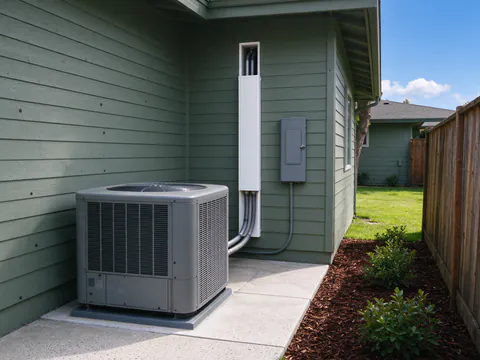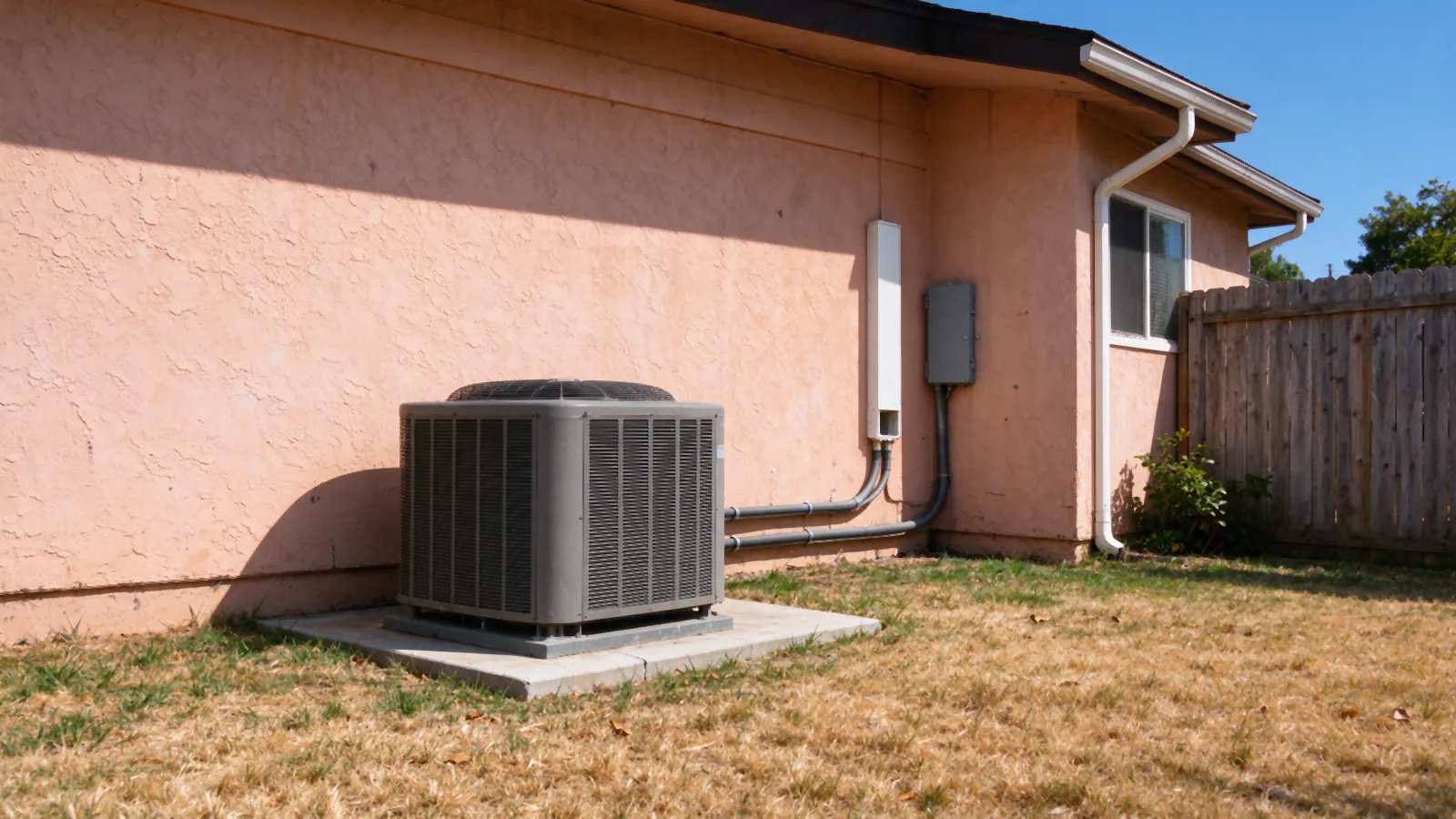
A heat pump cools exactly like a central air conditioner, so Sacramento’s heat is a question of capacity and airflow rather than technology. Sized from a load calculation at your town’s design temperature, with ducts that pass their test and an outdoor unit that can breathe, it carries a 100°F afternoon the same way a good AC does. The climate details below set those requirements.
Tule Sacramento Heat Pump designs and installs ducted heat pumps for Sacramento-area homes, with licensed and insured contractors doing the installation. This guide covers summer performance; the sizing guide covers the load calculation itself.
How hot it gets, town by town
NOAA’s 1991-2020 climate normals give Sacramento Executive Airport about 76 days a year at 90°F or above and 14 at 100°F or above. Other stations run hotter: Sacramento 5 ESE averages about 90 days at 90°F and 23 at 100°F, and Woodland about 96 and 21.
Design temperatures
A load calculation does not use the record high. It uses a design temperature from the California Energy Commission’s Reference Appendices (JA2), set so that only a small share of the year’s hours run hotter.
| Station | 1% cooling design | 0.1% cooling design | Daily range |
|---|---|---|---|
| Sacramento airport | 98°F | 104°F | 35°F |
| Davis | 97°F | 103°F | 41°F |
| Woodland | 100°F | 106°F | 40°F |
| Roseville | 100°F | 105°F | n/a |
| Rocklin | 103°F | 108°F | n/a |
| Galt | 95°F | 101°F | n/a |
At the 1% level, the design temperature is exceeded in about 1% of the year’s hours. That is why a correctly sized system may let the house drift a degree or two above the setting on the hottest afternoons and still be the right size.
The evening cool-down
The daily range matters as much as the peak. Sacramento’s design data shows a 35°F swing between afternoon and early morning, and Davis’s evening breezes push it to 41°F. Nights cool off enough for a house to shed heat, which favors pre-cooling and a system that can run gently through the evening.
Dry heat changes what the system works on
Cooling has two parts: lowering air temperature (sensible load) and pulling moisture out of it (latent load). NOAA’s hourly normals put the July mean dew point at Sacramento Executive Airport near 54°F, with a 3 p.m. normal of about 91°F, and the CEC’s design wet bulb is 70°F at 98°F. That is dry air.
In practice nearly all of a Sacramento cooling load is sensible. Equipment and airflow can be set up to favor temperature drop, within Title 24’s minimum of 300 cfm per ton, rather than slowing the blower to wring out humidity the way a Gulf Coast system would.
What happens inside a heat pump on a 100-degree afternoon
The outdoor coil works as the condenser in summer. It has to dump the heat collected from the house into outdoor air that is already hot, and the hotter that air, the harder the job.
Capacity and efficiency both slip
As outdoor temperature rises, refrigerant pressure on the hot side climbs, the compressor draws more power and the system delivers somewhat less cooling. Nominal tonnage is measured at a standard test point cooler than a Sacramento design afternoon. Manufacturers publish expanded performance tables that show capacity at higher temperatures, and a careful selection reads those tables for your design condition rather than trusting the nameplate.
Variable speed helps at both ends
A variable-speed heat pump runs flat out on the hottest afternoons and slows down the rest of the time. Two-stage equipment does something similar in two steps. Either gives better comfort through the long run of 90-degree days than a single-stage unit cycling on and off. Efficiency ratings behind this are explained in the SEER2 and HSPF2 guide.
The heat the system picks up on the way
Many Sacramento houses run their ducts through an attic, which on a summer afternoon is far hotter than the outdoor air. Cool supply air gains heat through the duct walls, and any leak on the return side draws attic air straight into the system.
Why duct sealing matters in summer
This is where Title 24’s change-out rules pay off. The installer seals the ducts connected to the new equipment, and an ECC-Rater tests them against a target of 10% total leakage or 7% leakage to the outside. Tight, insulated ducts deliver more of the capacity you paid for. Heat pump ductwork covers repair and replacement when the ducts fail.
Placing the outdoor unit for heat
The outdoor unit needs to pull in fresh air and throw its hot exhaust clear. Problems that cut capacity on hot days include:
- fences, shrubs or walls closer than the manufacturer’s clearances
- a unit tucked under a low overhang that traps rising exhaust air
- two units side by side, each breathing the other’s exhaust
- a coil clogged with cottonwood fluff, grass clippings or dust
The placement and noise guide covers clearances and the permit limits on moving a unit.
Running it through summer pricing
Cooling costs follow your electric utility’s rate design:
- SMUD. Summer runs June through September. The weekday peak, 5 to 8 p.m., costs $0.3765 per kWh on the standard Time-of-Day rate, against $0.2139 mid-peak and $0.1550 off-peak.
- PG&E. On the E-ELEC plan the peak runs 4 to 9 p.m. every day, at about $0.55 per kWh in summer.
- Roseville Electric. No residential time-of-use schedule; energy above 500 kWh a month moves to the higher tier, so total summer use is what counts.
On time-of-use rates, cooling the house slightly before the peak and letting it coast is the usual strategy. The electric bill guide runs the numbers.
Normal summer behavior and warning signs
Normal: long run times on 100-degree days, a house a degree or two warm late on a record afternoon, water dripping from the indoor condensate line.
Worth a call: ice on the refrigerant lines or indoor coil in July, an outdoor fan that does not spin, a breaker that trips, or a house that cannot hold the setting on an ordinary 95-degree day. Those point to airflow, charge or electrical faults, covered under heat pump repair.
Planning a system for the heat
If your old air conditioner has failed or is near the end, replacing it with a heat pump gives you the same summer cooling plus winter heat; the heat pump vs air conditioner guide compares the two. For a sized, written proposal, call (916) 516-1454 or request an estimate.