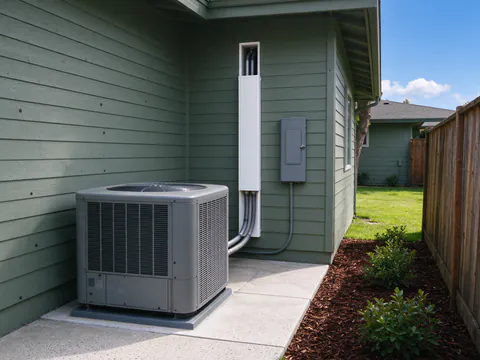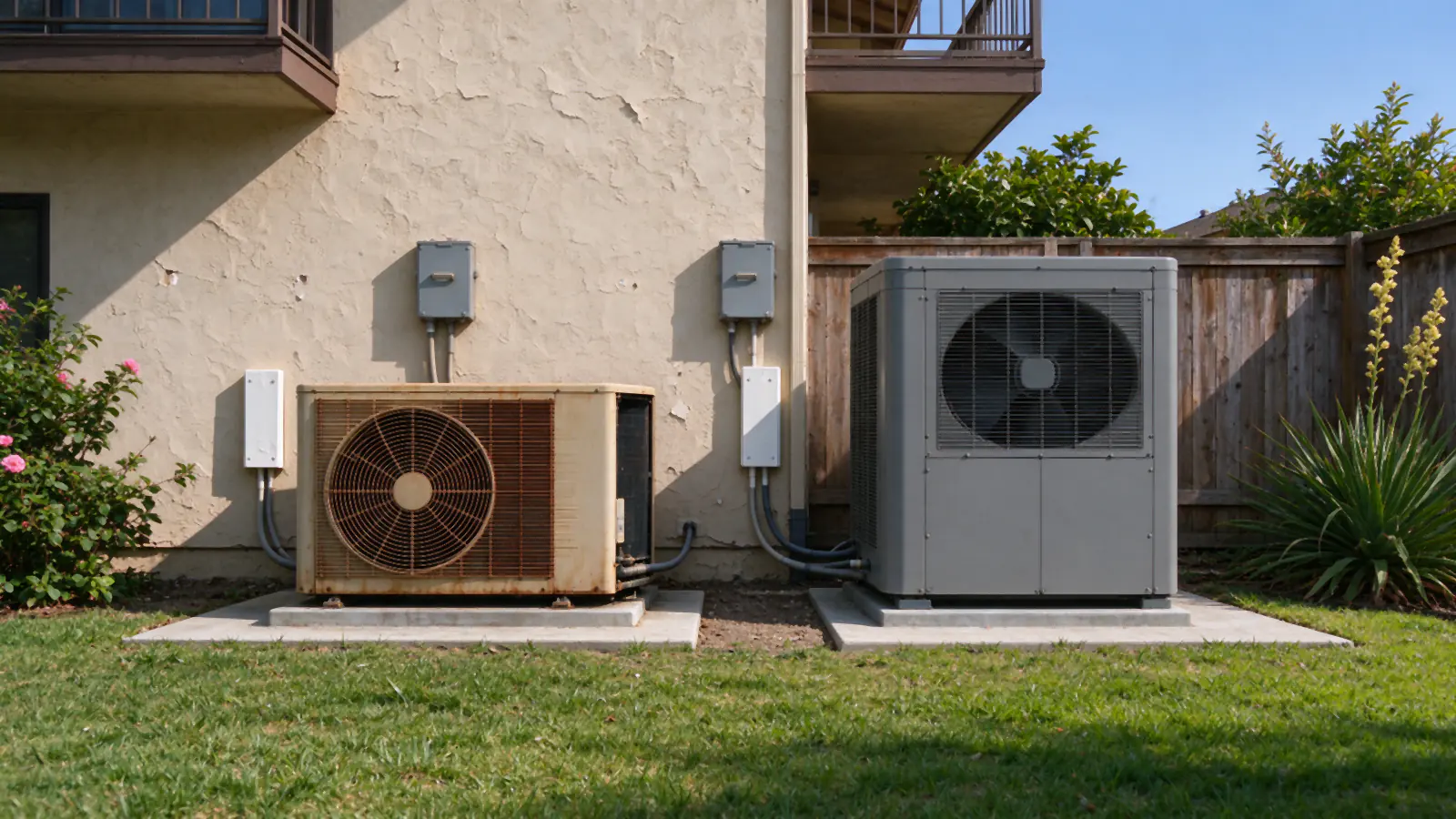
If the air conditioner has failed and you also heat the house, a heat pump is usually the better replacement around Sacramento. It cools exactly like an AC, then reverses to heat, which on SMUD power typically costs less than gas and earns a rebate an AC can’t. A new AC still makes sense when the furnace is young and the budget is tight.
Tule Sacramento Heat Pump replaces central air conditioners with heat pumps across the Sacramento region, with the installations done by licensed and insured contractors. This guide covers what is the same, what differs, and how the choice plays out under each local electric utility.
The one mechanical difference
A central air conditioner moves heat in one direction: out of the house. A heat pump adds a reversing valve that switches the direction refrigerant flows, so the outdoor coil can absorb heat in winter and the indoor coil can release it.
What comes with the reversing valve
- A defrost control. On damp mornings near freezing, frost builds on the outdoor coil. The heat pump briefly runs in cooling mode to melt it, which an AC never has to do.
- A heating rating. Heat pumps carry an HSPF2 rating for seasonal heating efficiency as well as a SEER2 rating for cooling. The SEER2 and HSPF2 guide explains both.
- Heat pump controls. The thermostat has to manage the reversing valve and any backup heat, so a basic cooling-only thermostat is replaced.
- Year-round duty. The outdoor unit works in both seasons instead of resting from October to May.
What stays the same
The compressor, coils, refrigerant lines, condensate drain and ducts do the same job in cooling mode. Both systems use the newer A2L refrigerants such as R-454B or R-32, and both need an indoor coil rated as a match for the outdoor unit.
Side by side
| Central air conditioner | Heat pump | |
|---|---|---|
| Cooling | Yes | Yes, the same way |
| Heating | No; the furnace does it all | Yes, most or all of the winter |
| Gas use | Unchanged | Reduced (dual fuel) or eliminated (full conversion) |
| Efficiency rating | SEER2 | SEER2 and HSPF2 |
| SMUD heat pump rebate | No | $3,000 or $2,000 gas-to-electric; $1,000 electric-to-electric, on qualifying systems |
| Title 24 on a change-out | Permit, duct sealing, refrigerant charge verification in climate zones 11 and 12 | Permit, duct sealing, refrigerant charge verification in every climate zone |
| Installed price | Lower for a like-for-like swap | Higher, offset by rebate and heating savings where they apply |
What each costs to run
In summer
Two systems with the same SEER2 rating, the same capacity and the same duct system use about the same electricity to cool. Variable-speed equipment can lower that by running slowly instead of cycling, especially through SMUD’s weekday 5 to 8 p.m. summer peak at $0.3765 per kWh, or PG&E’s 4 to 9 p.m. daily peak. The hot weather guide covers capacity on 100°F afternoons.
In winter
This is where the two diverge. With a new AC, the gas furnace keeps heating and the PG&E gas bill stays as it is. With a heat pump, heating moves to the electric bill. Derived from published rates, a heat pump beats a 95% gas furnace once its average COP passes about 1.4 at SMUD’s winter off-peak price, but needs about 3.1 to 3.5 on PG&E’s E-ELEC rate.
So in SMUD territory a heat pump is likely to lower the combined winter energy cost, while in PG&E areas such as West Sacramento, Davis and Rocklin the outcome depends on the rate plan and the equipment’s efficiency. The electric bill guide works through both.
Rules and testing either way
California does not require an existing home’s replacement air conditioner to be a heat pump; the state’s heat pump baseline in Title 24 applies to new construction. Whichever you choose, a permit is required.
The Title 24 checks
Replacing just the outdoor unit of a split system triggers duct sealing and an ECC-Rater test, according to the Energy Commission. Refrigerant charge verification applies to heat pumps in every climate zone and to air conditioners in zones 2 and 8 through 15, which includes the Sacramento area’s zones 11 and 12. So the testing burden is nearly the same. The permit and Title 24 guide explains each check.
What City permits show
City of Sacramento permit records use a standard description for this kind of job, “Change-out Split System to Split System (all-electric heat pump),” with the new unit in the same location and no more than 25% larger than the old one.
Three ways to replace a failed AC
| Option | What happens to heating | Fits best when |
|---|---|---|
| New AC, keep the furnace | Gas furnace heats as before | The furnace is fairly new and the budget is tight, or a heat pump’s winter costs on PG&E rates don’t pencil out |
| Heat pump, keep the furnace (dual fuel) | Heat pump heats most of the time; furnace covers the coldest hours | The furnace has years left, or winter electricity is expensive |
| Heat pump with a new air handler (full conversion) | Heat pump heats; furnace removed | The furnace is aging, especially on SMUD power |
Keeping the furnace
In a dual fuel setup the heat pump coil sits on the furnace and the furnace blower moves the air, so the blower has to deliver heat pump airflow, at least 300 cfm per ton under Title 24’s charge check. SMUD does not state whether dual fuel qualifies for its gas-to-electric rebate, so eligibility is confirmed before the equipment is ordered. Dual fuel heat pumps covers the controls and changeover point.
Retiring the furnace
A full conversion caps the gas branch, closes the flue and puts a heat pump air handler where the furnace stood. That is the path SMUD’s largest rebate targets. The conversion service page and the conversion cost guide cover the scope and price.
How common each is here
In the Energy Commission’s 2019 residential appliance survey, about 89% of SMUD households had central air conditioning and about 10% had a heat pump. In PG&E’s territory the figures were about 51% and 3%. For many Sacramento homes, then, a failed AC is the first natural chance to switch, because the outdoor unit is being replaced anyway. The survey predates more recent installations, and the heat pump share has grown since.
Which to choose
- SMUD power, furnace near the end of its life. A heat pump, likely a full conversion.
- SMUD power, furnace in good shape. A heat pump with the furnace kept as backup, then retire the furnace later.
- PG&E power. Compare a heat pump on the E-ELEC rate with a new AC; dual fuel often sits in the middle.
- Electric heat already. A heat pump replaces both the AC and the resistance heat; see heat pump replacement.
- A swamp cooler, not an AC. The evaporative cooler comparison covers that switch.
For a side-by-side quote on your own house, call (916) 516-1454 or request an estimate, or start with the cost estimator.