
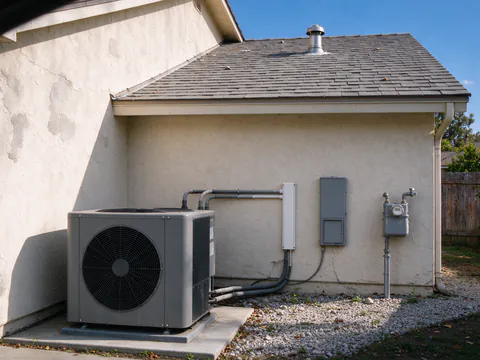
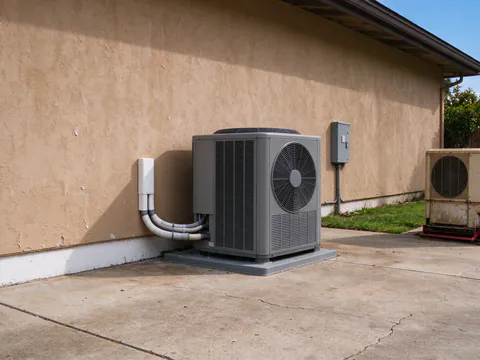
Rocklin has the hottest summer design temperature the Energy Commission lists anywhere in the Sacramento metro: 103°F at the 1% level, five degrees above Sacramento’s airport. Pair that with PG&E electricity instead of SMUD, and the heat pump question here leans on cooling more than on winter heating savings. Tule Sacramento Heat Pump plans and installs ducted heat pumps in Rocklin, Lincoln, Loomis and Granite Bay, with the work carried out by licensed and insured contractors.
Sizing for a 103-degree design day
What the design data says
The CEC’s Reference Appendices list Rocklin’s cooling design at 104°F at 0.5% and 103°F at 1%, with a heating design of 26°F at 0.2%. Loomis, higher up at 408 feet, lists 102°F and 27°F. Roseville next door lists 100°F and 30°F. Lincoln and Granite Bay have no station of their own, so their load calculations borrow the nearest listed one.
Why the old unit’s tonnage is the wrong starting point
A hotter design day raises the cooling load, but it does not mean the replacement should simply be a size up. Title 24 limits heat pump capacity on alterations where airflow is not verified at 350 cfm per ton, and an oversized system short-cycles through the long shoulder seasons. A room-by-room load calculation, the duct test and the airflow readings set the size. The heat pump sizing guide walks through the method, and heat pumps in hot weather covers how capacity behaves above 100°F.
Winter is colder, not harsh
A 26°F heating design is a few degrees colder than the valley floor, so the backup heat setting and defrost controls get checked rather than assumed. Damp, near-freezing mornings still mean frequent defrost cycles, and the outdoor unit is set where melt water drains away from the slab.
PG&E delivery, Pioneer generation
The Energy Commission’s utility layers place Rocklin, Lincoln, Loomis and Granite Bay in PG&E’s electric territory, with Pioneer Community Energy as the generation provider. PG&E supplies the gas too. That combination changes the running-cost math compared with SMUD or Roseville Electric.
| Electric rate (PG&E bundled) | Winter off-peak | Winter peak | Break-even heating COP vs 95% gas furnace |
|---|---|---|---|
| E-ELEC (heat pump households) | $0.28468/kWh | $0.32063/kWh | about 3.1 to 3.5 |
| E-TOU-C (default) | $0.36757/kWh | $0.39757/kWh | about 4.0 off-peak |
The break-even figures are derived from PG&E’s gas and electric tariffs, energy charges only. A heat pump has to deliver about three units of heat per unit of electricity on E-ELEC just to match a condensing furnace on winter fuel cost. For a Pioneer customer the generation portion follows Pioneer’s own rates, so the totals are checked against a recent bill.
What carries the case here
Because winter savings over gas are thin, most of the value comes from replacing the air conditioner with efficient cooling and retiring the furnace in one project. E-ELEC’s summer peak of $0.55214 per kWh from 4 to 9 p.m. rewards a variable-speed heat pump that runs slowly through the evening, and pre-cooling before 4 p.m. The electric bill guide compares the plans in more detail.
Rebates outside SMUD territory
SMUD’s heat pump rebates stop at its service boundary. TECH Clean California took its last reservations in November 2025, the federal HEEHRA rebates are fully reserved in California, and no PG&E single-family heat pump rebate was found. Any Pioneer program is confirmed directly with Pioneer. The California rebate guide tracks what is open.
Next door to Roseville Electric
Rocklin shares a long border with Roseville, and the two cities sit in the same Title 24 climate zone 11. The electric bill is where they part: Roseville Electric uses tiered pricing with no time-of-use schedule, while Rocklin households are on PG&E’s time-of-use plans. Near the line, the utility is confirmed from the meter, not the mailing address. The Roseville page covers that side.
Lincoln
Lincoln is the newest housing stock in the area: Census data puts 78.1% of its homes as built in 2000 or later and 91.5% as single-family detached.
Where a house has its original 2000s furnace in the attic, a conversion usually means a new air handler or coil in the same spot, a new outdoor unit and the Title 24 duct test on ducts that may never have been retested. Lincoln is PG&E and Pioneer territory in climate zone 11, and its permit rules are confirmed per address and project.
Loomis
Loomis sits higher than Rocklin and lists a 102°F cooling design at 1% with a 27°F heating design. The cooling load still governs the size. Loomis also gets PG&E delivery with Pioneer generation, and its permit path is confirmed per address and project.
Granite Bay
Granite Bay is unincorporated Placer County, so the permit comes from the County. Census data shows 39.0% of its homes built before 1980, 91.9% single-family detached and 90.0% owner-occupied. Older Granite Bay houses can carry original ducts and smaller electrical services, which is where ductwork and the panel guide come in.
Permits across south Placer County
The City of Rocklin issues permits inside city limits and Placer County issues them in Granite Bay. Each office’s HVAC permit specifics are confirmed per address and project. The state layer is the same everywhere: the CEC says installing a space-conditioning appliance requires a building permit, and a heat pump change-out triggers duct sealing and testing plus refrigerant charge verification by an ECC-Rater. Climate zone 11 changes the design data and the CF1R paperwork more than the alteration checklist. The permit and Title 24 guide explains each step.
The order of a south Placer project
- Utility check. Confirm PG&E delivery, Pioneer generation and the current rate plan from a recent bill.
- Load and ducts. A load calculation at the local design temperature, a duct inspection and static pressure readings.
- Panel. The service size and open breaker spaces, before any backup heat is chosen.
- Scope and permit. An itemized written scope, then the City or County permit.
- Install and verify. The old refrigerant recovered, the new system set, line sets brazed, held under pressure and pulled into a deep vacuum before charging, then airflow and charge readings ahead of the ECC-Rater’s visit.
For a house with a gas furnace and AC, the starting point is a gas furnace to heat pump conversion. Where the furnace still has years left, a dual fuel heat pump is worth comparing on PG&E rates. The Sacramento cost guide shows what moves the price.