
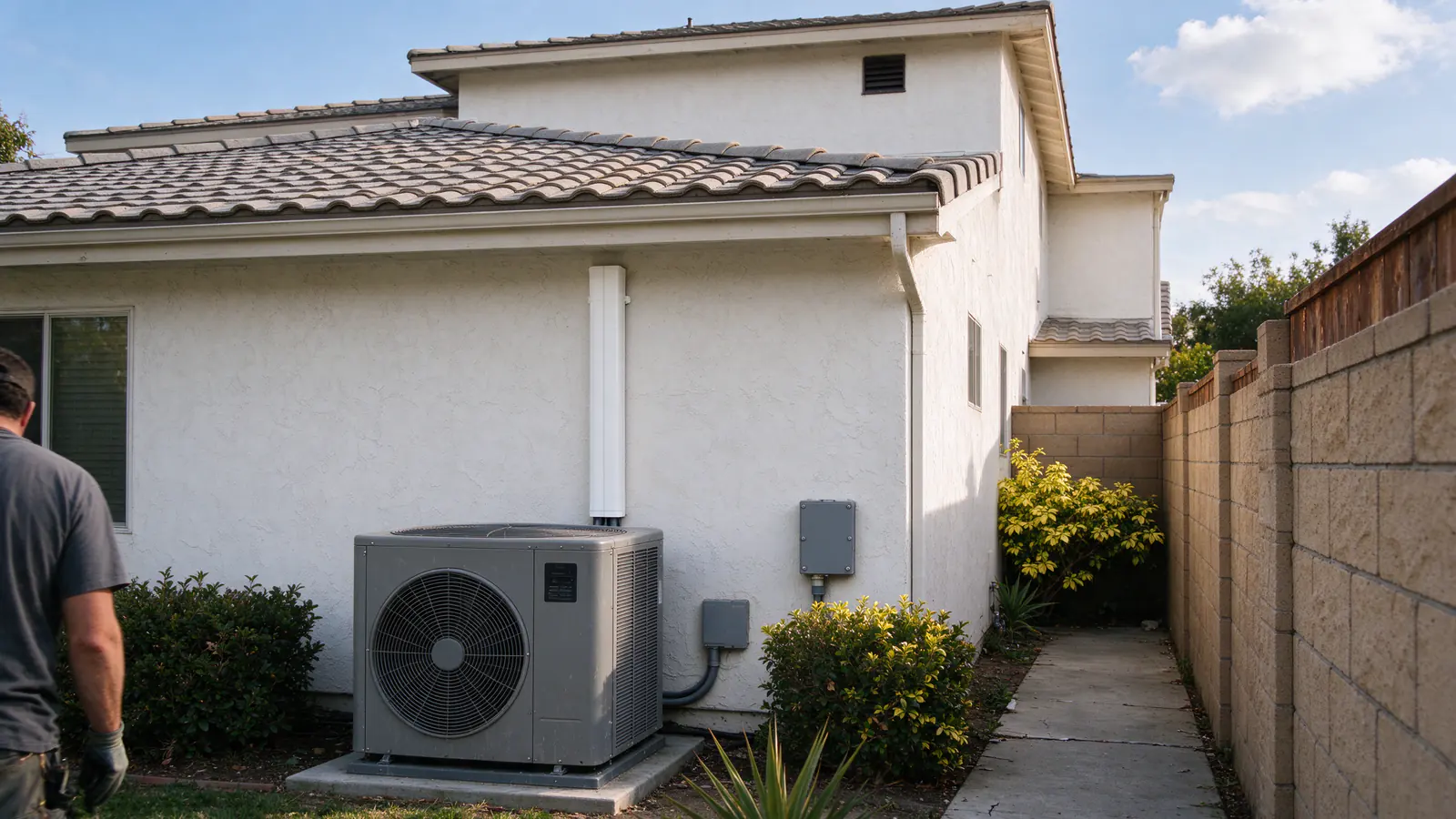
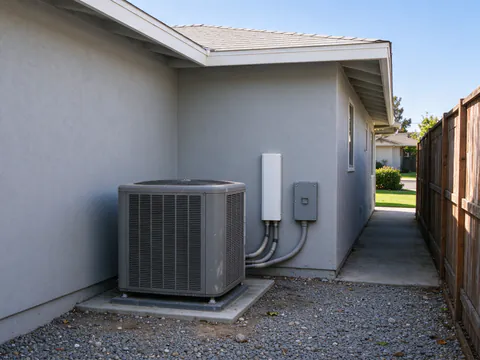
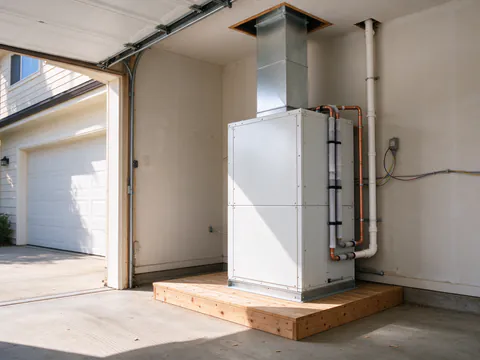
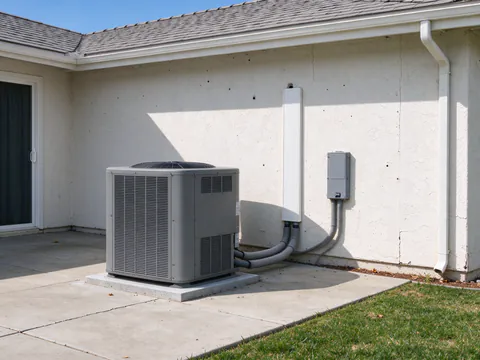
A Roseville homeowner reading about SMUD’s heat pump rebates will find they stop at the city line. Roseville buys its power from its own municipal utility, Roseville Electric, and that changes the rebate, the rate structure and the running-cost math at once. Tule Sacramento Heat Pump installs and converts ducted heat pumps across Roseville, from Old Roseville and Diamond Oaks to West Roseville, Highland Reserve and Sun City Roseville, with licensed and insured contractors doing the work.
No SMUD rebate on this side of the line
The California Energy Commission’s utility maps show Roseville Electric serving Roseville, with PG&E supplying gas. SMUD’s rebates require an active SMUD account, so they don’t apply here.
What is left
- Roseville Electric. Its residential rebates page lists EV programs, PowerFlex, home energy reports and solar, with no residential heat pump HVAC rebate. Ask the utility before buying in case a program returns.
- Statewide. TECH Clean California stopped taking reservations on November 14, 2025, and California’s HEEHRA rebates are fully reserved.
- Federal. The 25C tax credit for heat pumps has ended.
The California heat pump rebate guide tracks what reopens. For budgeting, the price before rebates is the working figure.
Tiered pricing instead of time of day
Roseville Electric prices residential energy in two tiers and lists no residential time-of-use schedule:
| Charge | Roseville Electric |
|---|---|
| Tier 1, first 500 kWh a month | $0.1469 per kWh |
| Tier 2, above 500 kWh | $0.1912 per kWh |
| With renewable, GHG, hydro and state surcharges | About $0.1546 and $0.1989 |
| Basic service charge | $30.00 per meter a month |
What tiers do to a heat pump bill
Because the price depends on how many kWh the house uses in the month, not when, the hour a heat pump runs matters less than how efficiently it runs over the season. Any heat pump use beyond the house’s first 500 kWh in a month is billed at the Tier 2 price.
Measured against PG&E’s baseline gas rate, the derived break-even for beating a 95% furnace is a COP of about 1.70 in Tier 1 and 2.18 in Tier 2, against 1.41 to 1.95 on SMUD. The heat pump electric bill guide runs the numbers.
The OPS Portal checklist and the attic question
How the permit starts
Roseville’s Building Division handles HVAC replacements through its OPS Portal. Under the City’s Residential Mechanical Electronic Submittal Checklist, a pre-application starts under Residential, then home repair or maintenance, then heating, ventilation and air conditioning replacement. The Residential HVAC Alteration Form CF1R-ALT-04-E is attached, and a payment request follows once the City processes it.
When stamped plans come in
The checklist adds one line that matters wherever the furnace sits in the attic: if a new mechanical unit goes in the attic or on top of an existing roof, complete, stamped and signed building plans are required. Read literally, that can cover an air handler replacing an attic furnace, so the requirement is confirmed for the specific scope before the quote is final. Where plans are needed, they add time and cost to the job.
Climate zone 11 and a 100°F design day
The CEC’s design data for Roseville gives 100°F for cooling at the 1% level, 102°F at 0.5% and 105°F at 0.1%, with a heating design of 30°F at 0.2%. That is two degrees hotter at the 1% level than Sacramento Airport. The CEC’s climate zone map places Roseville in zone 11, while Sacramento is in 12.
What changes and what doesn’t
The extra degrees go into the cooling load, which usually sets the size on the valley floor, and a room-by-room calculation shows whether they move the tonnage. The heat pump sizing guide explains the method. For Title 24 alterations, zones 11 and 12 fall in the same prescriptive bands, so the duct test, charge verification and R-8 rule for new ducts are the same; the forms and design data are what differ.
Gas furnace, AC or both
The Census Bureau’s American Community Survey counts 45.5% of Roseville’s homes as built in 2000 or later and 17.3% before 1980; 68.3% of households heat with gas and 28.6% with electricity. The scope usually follows from the equipment that is failing.
- Both near the end. A full gas furnace to heat pump conversion, with the gas line capped and the flue sealed.
- AC failing, furnace young. A dual fuel heat pump keeps the furnace for cold mornings. With Roseville’s narrower operating-cost gap, the switchover temperature is worth setting carefully.
- Existing electric heat. A heat pump replacement with a new air handler.
On a 100°F design day, a variable-speed heat pump can run steadily rather than cycling at full output.
Across the line in Rocklin and Granite Bay
Roseville Electric’s territory ends at the city limits. The CEC’s maps put Rocklin and Granite Bay on PG&E delivery with Pioneer Community Energy generation, which changes the heating math again: on PG&E’s E-ELEC rate the derived break-even against a 95% furnace climbs to a COP of about 3.13 to 3.52. Rocklin also carries a hotter design, 103°F at the 1% level.
So two houses a mile apart, one on each side of the Roseville-Rocklin line, can get different equipment advice from the same load calculation. The utility on the bill is confirmed at the first call, and the Rocklin page covers that side of the line.
How a Roseville project moves
- Intake. The system’s age, where the indoor unit sits, whether the bill comes from Roseville Electric, and the address.
- Visit. Room-by-room loads, duct leakage and static pressure, the panel, and the outdoor unit’s spot with defrost drainage.
- OPS Portal. The pre-application filed with the CF1R-ALT form, plus plans if the attic or roof rule applies.
- Installation. Refrigerant recovered, equipment replaced, lines brazed, evacuated and charged.
- Verification. Airflow and charge confirmed, the ECC-Rater test, the City’s inspection and the thermostat setup. The Sacramento cost guide and permit guide cover each step’s cost and paperwork.