
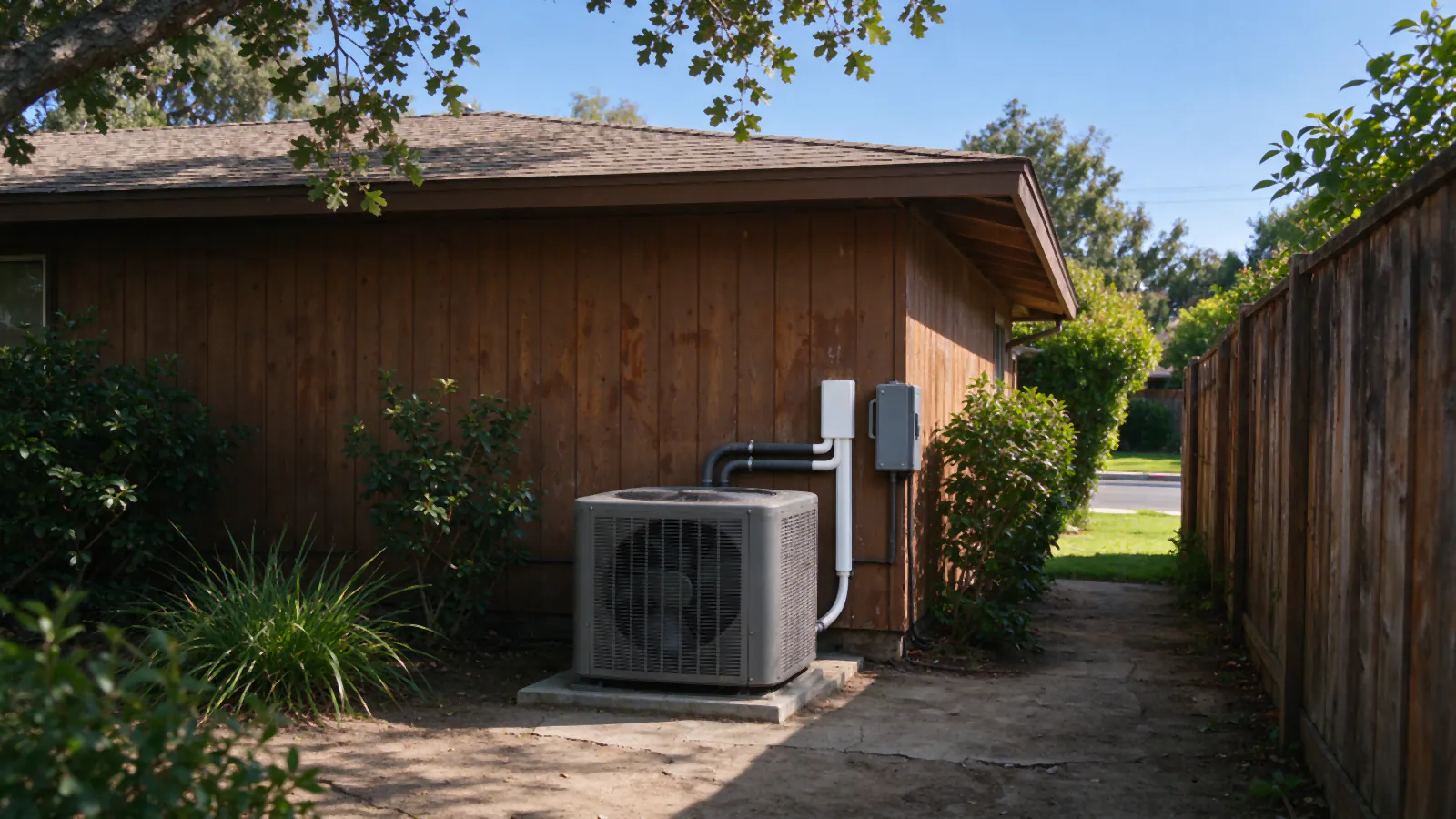
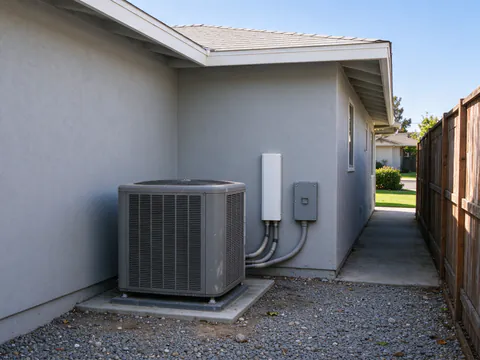
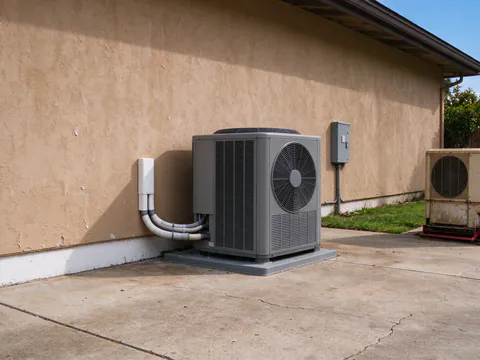
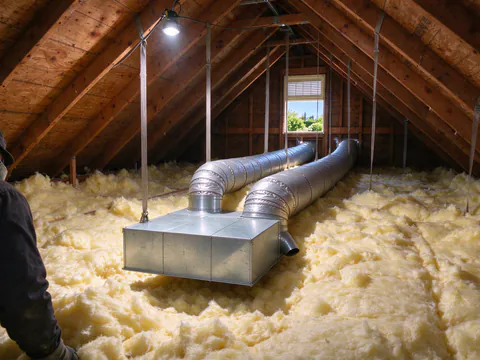
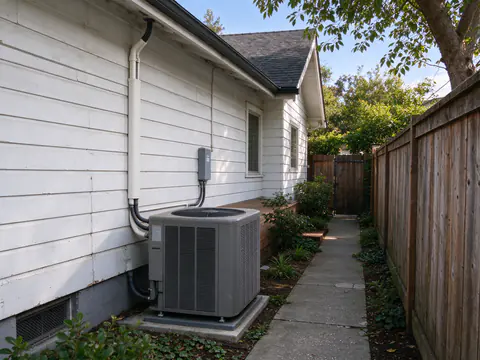
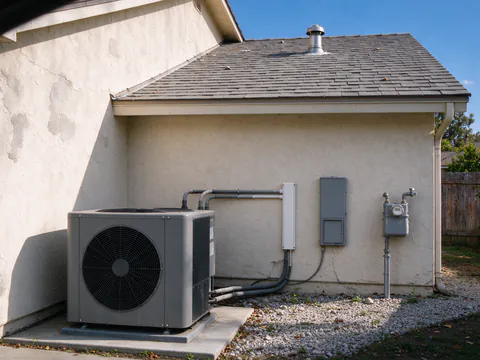
Carmichael, Fair Oaks and Arden-Arcade have no city hall. All three are unincorporated communities of Sacramento County, so the heat pump permit for a house here comes from the County’s Building Permits & Inspection office rather than the City of Sacramento, even when the mailing address says “Sacramento.” Tule Sacramento Heat Pump installs, replaces and converts ducted heat pumps across these three communities and the neighboring County areas of Orangevale, North Highlands and Antelope, with the work carried out by licensed and insured contractors.
Older houses, original ducts
The houses add the second local factor. Much of the housing here went up between the 1950s and the 1970s, and where a house still has its original ducts and electrical service, those two things set the scope more than the climate does.
Permits go through Sacramento County
A heat pump change-out in Carmichael, Fair Oaks or Arden-Arcade is permitted by Sacramento County. The County’s FAQ lists residential heating and cooling, new install or replacement, among the permits that can be applied for online and issued automatically once the fee is paid through its Citizen Access Portal. The ECC-Rater verification and final inspection still follow the installation.
How the County path differs from the City
That differs from the City of Sacramento, whose web permit for a heat pump change-out generally keeps the new unit in the old location and within 25% of the old unit’s size. The County sets its own permit fee, which appears as its own line in the quote. Some ZIPs that serve Arden-Arcade, such as 95825, also include addresses inside city limits, so the jurisdiction is checked by parcel before the permit is pulled. The permit and Title 24 guide explains both paths.
How a job here usually runs
The sequence follows the trade’s standard steps, with two checks moved to the front because of the housing stock.
- First call. The current system and its age, how the house heats today, which rooms are hard to keep comfortable, and confirmation that SMUD supplies the electricity.
- Assessment. A room-by-room load calculation, a duct inspection with static pressure readings, the panel’s size and open spaces, and where the outdoor unit can sit.
- Scope and permit. A written, itemized scope, then the County permit applied for online.
- Installation. Old refrigerant recovered, old equipment removed, the new outdoor unit and matched air handler or coil set, lines brazed, pressure-tested and evacuated before charging.
- Verification. Airflow, charge and backup heat checked, the ECC-Rater visit for duct leakage and refrigerant charge, and the thermostat walked through.
Ranch houses from the 1950s to the 1970s
What the Census numbers say
The U.S. Census Bureau’s American Community Survey puts 76.8% of Arden-Arcade’s homes and 70.5% of Carmichael’s as built before 1980, along with 58.7% in Fair Oaks. In the 95864 ZIP around Arden Park, 50.7% of homes predate 1960 and the median home was built in 1960. Carmichael’s 95608 has a median year built of 1972, and Fair Oaks’ 95628 is 1975. Those are neighborhood figures, not a finding about any one house.
Ducts from the original build
Where a house still has its original duct system, a heat pump makes its weaknesses visible. A heat pump needs at least 300 cfm of airflow per ton to pass its refrigerant charge verification, and returns sized for a 1960s furnace can fall short. The Title 24 leakage test on the change-out shows how much conditioned air is being lost. Sealing joints and boots, adding a return or replacing the worst runs often follows from that result, and heat pump ductwork covers each option.
Panels from the same era
Where the house still has an older 100-amp service, the panel is checked before equipment is chosen, since backup heat strips can add a large load. SMUD treats panels of 125 amps or smaller as a separate customer class for its low-use rate, a reminder that small services are part of its territory. The electrical panel guide and heat pumps for older homes explain the extra steps.
Gas furnace or electric heat: two starting points
Most households here heat with gas, but a large minority do not. ACS data shows 42.9% of Arden-Arcade households and 37.9% in Carmichael heat with electricity, against roughly 58% to 75% gas heat across the three ZIPs. The starting point changes the job.
| Starting point | Typical job | SMUD rebate on qualifying equipment |
|---|---|---|
| Gas furnace and central AC | Gas furnace to heat pump conversion | Up to $3,000 variable-stage, $2,000 two-stage |
| Ducted electric furnace or older heat pump | Heat pump replacement | $1,000 electric-to-electric |
| Newer gas furnace with years left | Dual fuel heat pump | Eligibility not stated; confirmed first |
Arden-Arcade also has a lot of multi-unit housing: 45.2% of its homes are in buildings of two or more units. Condos and townhomes can involve shared roofs, HOA rules or package units, so those details are confirmed per building.
SMUD power, PG&E gas
The California Energy Commission’s utility maps place all three communities in SMUD’s electric territory, with PG&E supplying gas. That pairing is what makes a heat pump cheap to run here. SMUD’s standard Time-of-Day rate charges $0.1285 per kWh off-peak in winter and $0.1776 at the 5 to 8 p.m. peak. Against PG&E’s residential gas rate, a heat pump beats a 95% furnace on fuel cost once it delivers about 1.4 to 2 units of heat per unit of electricity, a figure derived from the two tariffs.
SMUD’s heat pump rebates require qualifying equipment installed by a participating contractor in the SMUD Contractor Network, permits and a passing Title 24 verification. Rebate-qualified installations are available on request. The SMUD rebate guide lists every condition.
Winter mornings and summer afternoons
The CEC’s design data for Carmichael, Fair Oaks and Arden gives the same 98°F cooling design at the 1% level and 104°F at 0.1%. Heating designs at 0.2% run from 29°F in Fair Oaks to 33°F in Arden and 35°F in Carmichael. All three sit in Title 24 climate zone 12, so the alteration rules match the rest of Sacramento County.
Near-freezing, damp winter mornings mean frequent defrost cycles, which is why the outdoor unit is set where melt water drains away from the foundation. The heat pump vs gas furnace guide and the Sacramento cost guide carry the numbers further.