
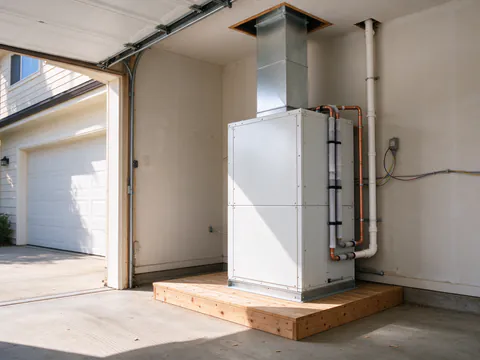
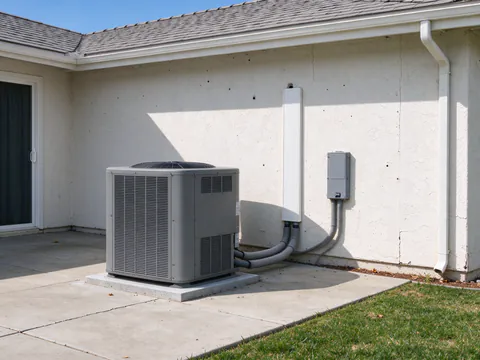
A heat pump for a house built before 1950 in Land Park, Curtis Park or East Sacramento gets decided as much in the crawlspace, the attic and the electrical panel as at the outdoor unit. Tule Sacramento Heat Pump plans and installs ducted heat pumps across these neighborhoods and the rest of the city’s central grid, and licensed and insured contractors do the installation.
Houses built before 1950
What the ZIP figures show
In 95818, the Land Park and Curtis Park area, 65.7% of homes were built before 1950 and 73.3% before 1960, according to Census American Community Survey estimates. East Sacramento’s 95819 has 77.8% of its homes from before 1960, and 81.1% are single-family detached. Those shares describe the neighborhood; they say nothing certain about a particular house.
Why the age matters for a heat pump
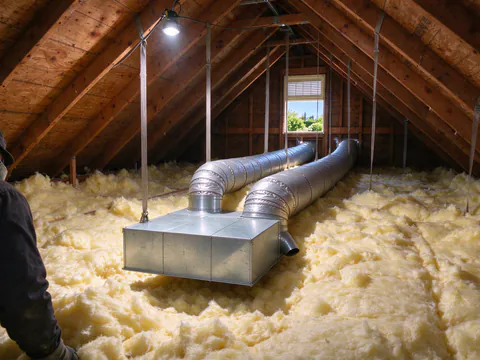
A house from the 1920s or 1930s may have had ducts added decades after it was built, or never had them at all. If a duct system was fitted for an early furnace and a small AC, it may be undersized for a heat pump. Title 24’s charge verification requires a minimum of 300 cfm per ton of airflow, and undersized returns are one way an old system falls short of it. The heat pumps for older homes page covers the full checklist.
The permit choice that sets the scope
The City of Sacramento issues one- and two-family HVAC permits through its online minor-permit portal. Its standard change-out text has two duct variants that matter here:
- No Duct Work Permitted. The heat pump connects to the existing ducts, which are then sealed and tested by an ECC-Rater.
- Change-out w/new ducts. New or rebuilt ducts are part of the permitted scope and are inspected with the equipment.
Across the City’s 1,950 heat pump permits issued in the 12 months to October 25, 2026, 1,167 carried the no-duct-work condition and 176 the new-duct option. In a pre-war house, the duct inspection decides which box gets checked, and the permit and Title 24 guide walks through both paths.
Title 24 rules when ducts are new
Reusing the old system
When existing ducts stay, the CEC’s compliance manual sets a target of 10% or less total leakage, or 7% or less to outside. If the ducts can’t reach it, every accessible leak is sealed and confirmed by visual and smoke test. Ducts with asbestos are listed among the exceptions to that test, which is why they are identified before anyone opens them up.
Adding runs or a whole new system
More than 25 feet of new duct must be insulated to R-8 in climate zone 12 and leakage-tested. An entirely new duct system must hold total leakage to 5% or less and meet filtration and fan airflow requirements. That is a higher bar than resealing old ducts, and it is priced as part of the heat pump ductwork scope rather than as an extra.
Electrical service in a pre-war house
Where a house still runs on an older, smaller service, the panel is assessed before the heat pump is chosen. The outdoor unit needs its own 240-volt circuit, and electric strip heat in the air handler draws heavily on the coldest mornings. If a panel upgrade to 200 amps is needed, it goes on its own permit.
City permit data shows how common that pairing is: from January 1 to October 25, 2026, 719 City permit descriptions mentioned a main service panel or a panel upgrade. The heat pump electrical panel guide explains how the load is calculated and when an upgrade can be avoided.
Placing the outdoor unit on a city lot
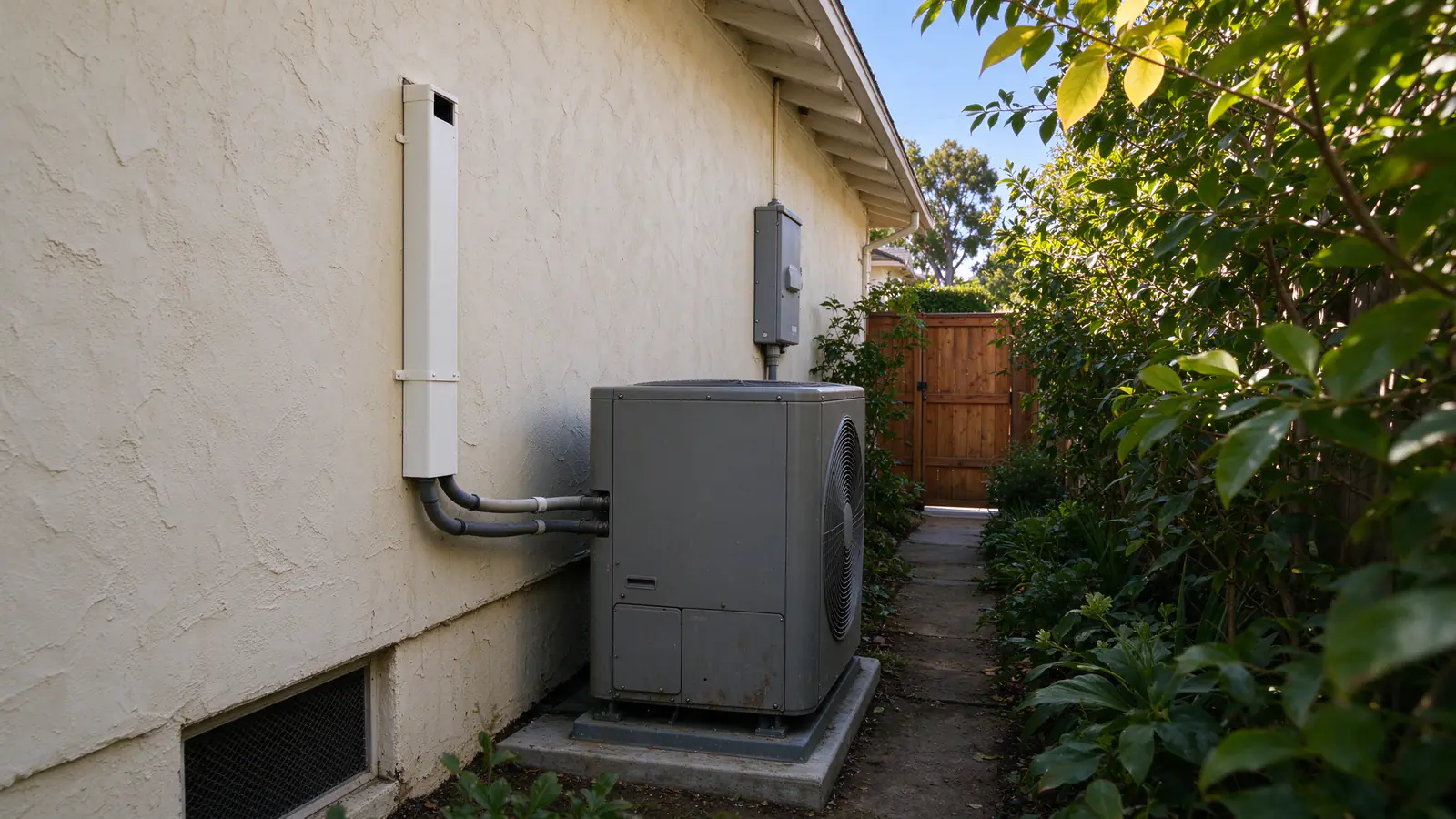
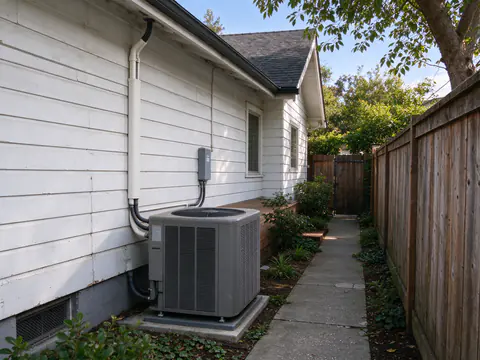
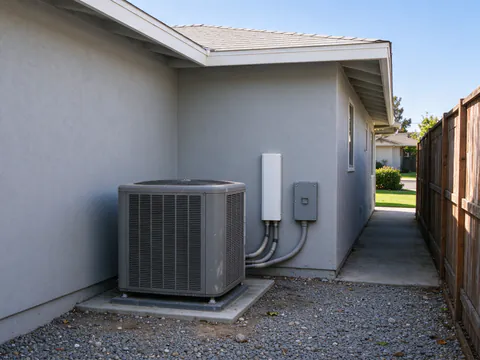
The City’s standard web change-out requires the new unit to sit “in the same location as the existing unit” and caps any size increase at 25%. In a neighborhood of narrow side yards, that rule has two practical effects:
- Sizing stays close to the old unit. If the load calculation calls for more than 25% above the old unit’s size, the job moves out of the standard path.
- Relocation is a decision, not a detail. Moving the unit away from a bedroom window or a neighbor’s fence means a permit scoped for it.
The placement and noise guide covers clearances, drainage and sound. Many City change-out records also note that carbon monoxide and smoke alarms are required, so those are checked at the inspection too.
How a job in these neighborhoods runs
- First call. What heats and cools the house now, roughly when it was built, which rooms never get comfortable, and whether every room has a register.
- Assessment. Heating and cooling loads worked out per room, static pressure measured across the existing ducts, any asbestos wrap noted, breaker capacity counted, and a spot chosen for the outdoor unit.
- Scope and permit. A written scope naming the duct approach and any electrical work, then the City permit filed with the duct option that matches it.
- Installation. The old refrigerant is recovered and the old equipment hauled out. The outdoor unit and a matched air handler go in, and the line set is brazed, pressure-tested and pulled into a vacuum before it is charged.
- Verification. Airflow, refrigerant charge and the backup heat stages are confirmed, then the ECC-Rater test, the City inspection and a walk-through of the thermostat.
Running costs and rebates on SMUD power
East Sacramento, Land Park and Curtis Park are SMUD territory, with gas from PG&E. Outside summer, SMUD’s Time-of-Day schedule prices electricity at $0.1285 a kWh off-peak and $0.1776 in the weekday evening peak. Set those against PG&E’s baseline gas charge and the break-even works out to a heat pump COP of roughly 1.41 to 1.95 compared with a 95% furnace. That is a derived comparison of energy charges, leaving fixed charges out.
What SMUD offers
A gas-to-electric replacement can earn up to $3,000 with a variable-stage heat pump, or $2,000 with two-stage equipment, on qualifying equipment installed by a participating contractor in the SMUD Contractor Network, with permits and a passing Title 24 verification. SMUD also offers additional rebates for panel and circuit work on gas-to-electric projects. Ask for a rebate-qualified installation when you call; the SMUD rebate guide sets out every condition.
Variable speed in an older shell
Older, leakier houses swing faster on 98°F afternoons, the CEC’s 1% cooling design for Sacramento. A variable-speed heat pump can run long and slow instead of cycling hard, which helps rooms at the end of long duct runs. The Sacramento cost guide shows where duct and panel work move the price.