
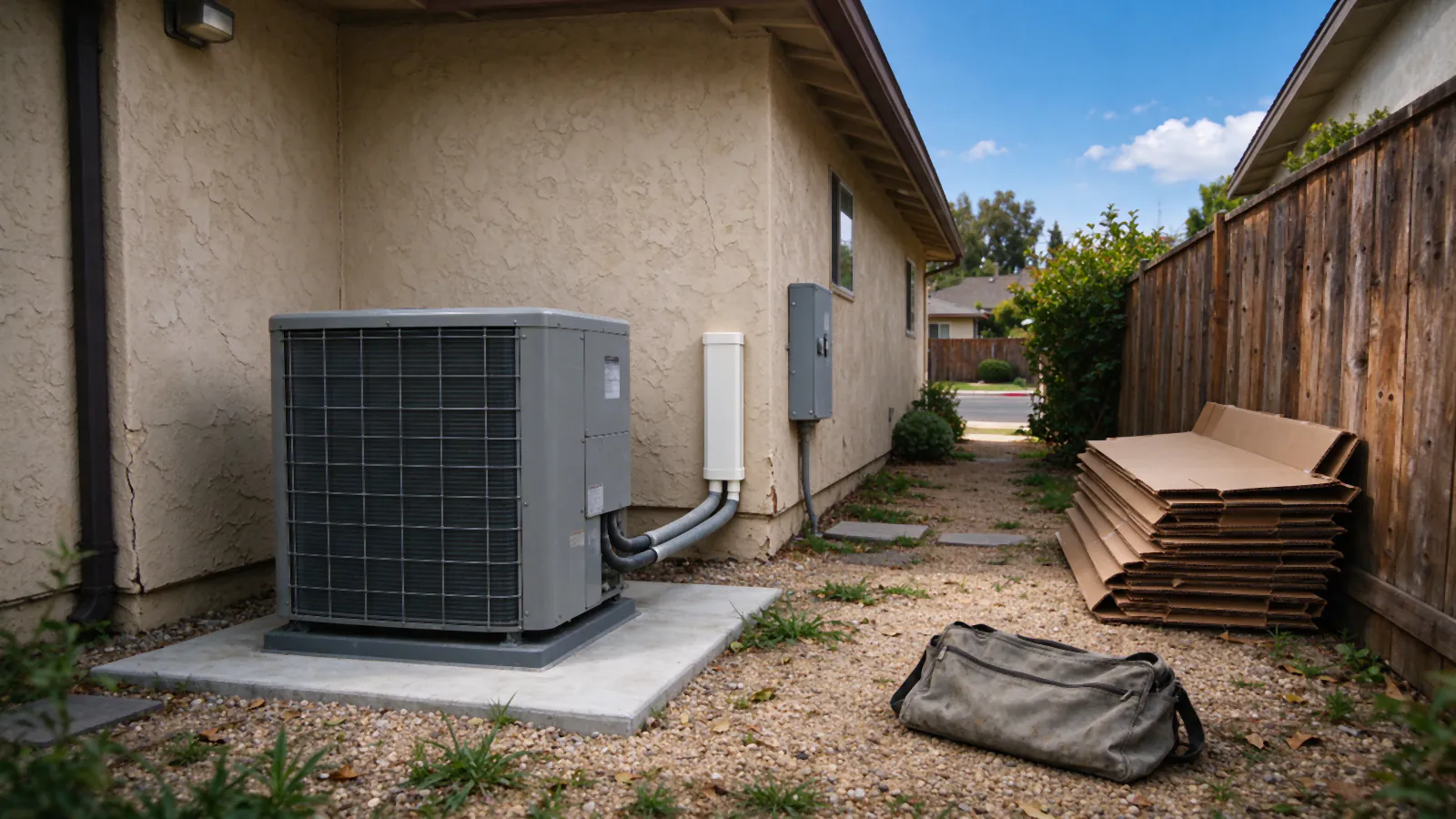
A ducted heat pump installation follows a fixed order: assess the house, size and select the system, pull the permit, remove the old equipment, set the new indoor and outdoor units, run and test the refrigerant lines, wire and commission the system, then pass Title 24 verification and the final inspection. Each step depends on the one before it, and skipping ahead is how jobs go wrong.
Tule Sacramento Heat Pump manages ducted heat pump installations across the Sacramento region, with licensed and insured contractors performing the work. The steps below are the standard trade sequence; the proposal for a specific house sets out its own scope and schedule.
Before any equipment is chosen
The site assessment
The first visit gathers what the design needs:
- room measurements, windows, insulation and orientation for the load calculation
- the duct system: where it runs, its condition, return sizes and, ideally, a static pressure reading
- the electrical panel and service size, and room for a new circuit
- the outdoor location, clearances and drainage
- the line-set route, condensate route and thermostat wiring
Load calculation, then selection
The load calculation sets the capacity; the capacity and the duct assessment together decide the equipment. Pick a heat pump before testing the ducts, and you can end up with one the ducts cannot feed. The sizing guide explains how the calculation works.
The proposal
A complete proposal names the matched outdoor unit and indoor coil or air handler, the duct work, the electrical work, the permit and the Title 24 verification. Where SMUD’s rebate applies, it covers qualifying equipment installed by a participating contractor in the SMUD Contractor Network; rebate-qualified installations are available on request. The quote comparison guide lists what to look for.
The permit
The permit is applied for before work starts, along with the Title 24 compliance form (CF1R-ALT) that describes the alteration.
| Area | How the permit is issued |
|---|---|
| City of Sacramento | Online minor permit for one- and two-family homes |
| Unincorporated Sacramento County | Online application, issued automatically once paid |
| Elk Grove | Online residential mechanical permit with separate HVAC replacement types |
| Roseville | OPS Portal pre-application with the CF1R-ALT HVAC form; stamped plans for a new attic or roof unit |
| El Dorado County | Email permit program for licensed contractors |
A panel upgrade or new circuit has its own electrical permit. The permit and Title 24 guide covers every office.
Removing the old system
Refrigerant recovery
The refrigerant in the old system is recovered into a cylinder with a recovery machine, never vented. Then the outdoor unit, indoor coil or air handler come out.
In a conversion
When a gas furnace is being retired, the gas supply to it is shut off and capped and the old flue opening is closed. The furnace cabinet leaves with the old coil. The conversion service page covers that scope in detail.
Setting the new equipment
Outdoor unit
The unit goes on a level pad with the manufacturer’s clearances and drainage for defrost water. The placement guide covers location choices.
Indoor unit
The air handler goes in the attic, garage or closet, connected to the supply plenum and return with sealed transitions. The condensate drain is run with the slope and trap it needs, and overflow protection is added where the unit sits above a finished ceiling.
The refrigerant lines
This is where an installation’s long-term reliability is decided.
- Run or reuse the line set. New lines are run, or existing lines are checked for size, condition and cleanliness before reuse.
- Braze with nitrogen flowing. Nitrogen inside the pipe while brazing keeps scale from forming on the inside of the joints.
- Pressure test. The lines and coil are pressurized with nitrogen and checked for leaks.
- Evacuate. A vacuum pump pulls air and moisture out, confirmed on a micron gauge, so no moisture is left to form acids later.
- Release and charge. The refrigerant is released and the charge is adjusted to the manufacturer’s specification.
New systems use A2L refrigerants such as R-454B or R-32, explained in the R-454B guide.
Electrical and controls
The outdoor unit gets its 240-volt circuit and a disconnect within sight of the unit. The air handler and any backup strips are wired, and the thermostat is connected. Title 24 requires a digital setback thermostat when refrigerant components are replaced; SMUD’s rebate requires a Wi-Fi seven-day programmable connected thermostat.
Commissioning
Commissioning proves the system runs as designed. Airflow comes first, because charge readings depend on it.
- Airflow setup. Blower speed set for the system’s capacity and the duct system, checked against static pressure, with at least 300 cfm per ton for Title 24’s charge check.
- Refrigerant charge. Verified against the manufacturer’s method once airflow is right.
- Heating, cooling and defrost. Both modes run and the defrost control checked.
- Backup heat. Strip staging set and the outdoor lockout configured so strips run only when needed, as the aux heat guide explains.
- Condensate. Drain tested for flow.
- Thermostat. Schedule, setback and fan settings set up and explained.
Duct sealing and ECC-Rater verification
Under Title 24, the installer seals the ducts connected to the new equipment, and an independent ECC-Rater tests duct leakage, refrigerant charge and airflow. The duct target is 10% total leakage or 7% to the outside. A failed test means more sealing and a retest. Passing results are recorded on the CF3R, which SMUD’s rebate also requires. Heat pump ductwork covers what happens when the ducts need more than sealing.
The final inspection
The building inspector checks the installation against the permit. On City of Sacramento change-outs, the permit notes that carbon monoxide and smoke alarms are required, so test them beforehand. Under SB 222, cities and counties must offer asynchronous inspections from July 1, 2027, which can change how this step is scheduled.
Handover
The walkthrough covers how the system heats, cools and defrosts, what the thermostat settings do, where the filter is and how often to change it, and what normal sounds and frost look like. Manufacturer warranty registration has its own terms, and on a SMUD rebate-qualified installation the program has the participating contractor submit the rebate. The Sacramento cost guide shows what each step adds to the price. To plan an installation for your house, call (916) 516-1454 or request an estimate.