No honest single number answers how long a heat pump will last. Service life depends on how it was sized and installed, how hard the climate and the house make it work, and how it is maintained. In Sacramento one outdoor unit cools through the summer and heats through the winter, so it builds hours faster than an air conditioner that rests half the year. Most of what shortens that life can be controlled.
Tule Sacramento Heat Pump replaces and installs ducted heat pumps across the Sacramento region, with licensed and insured contractors doing the work. This guide explains what wears a system out and how to decide when replacement makes sense, without promising a lifespan nobody can guarantee.
Why a Sacramento heat pump works hard
A heat pump runs in both seasons. In summer it carries the cooling load through roughly 76 days a year at 90°F or hotter at Sacramento Executive Airport, by NOAA’s normals. In winter it heats, and on damp, near-freezing mornings it defrosts its outdoor coil, reversing the refrigerant flow each time.
Summer stress
On a 100-degree afternoon the outdoor coil has to reject heat into air that is already hot. Pressures and temperatures in the system rise, and the compressor and electrical parts work harder. Long run hours in heat are normal; a system that also has a dirty coil or a poor charge runs hotter still.
Winter cycles
Each defrost is a short change of direction for the refrigerant and the reversing valve. That is part of normal operation in tule-fog season, but a system with weak airflow or a charge problem frosts faster and defrosts more often.
What shortens a heat pump’s life
Oversizing
A system too large for the house reaches the thermostat setting quickly, stops and restarts. Every start is a moment of high stress on the compressor and its electrical parts. Title 24 limits how far a replacement may exceed the load unless airflow is verified at 350 cfm per ton, and the sizing guide explains why that matters.
Wrong refrigerant charge
Too little refrigerant makes the compressor run hot and can starve it of the oil that travels with the refrigerant. Too much can push liquid back to the compressor. Either way, wear accelerates. Title 24 requires charge verification on heat pumps in every climate zone, confirmed by an ECC-Rater.
Starved airflow
Ducts too small for the system, a restrictive filter or a crushed return leave the indoor coil short of air. In summer it can ice; in winter the system leans on backup heat. Title 24’s charge check assumes at least 300 cfm per ton. Heat pump ductwork covers the fixes.
Installation shortcuts
Moisture or debris left in the lines during installation can form acids and sludge that attack the compressor over time. Brazing with nitrogen flowing, a pressure test and a deep evacuation confirmed on a micron gauge prevent that. The installation process guide lays out each step.
The outdoor environment
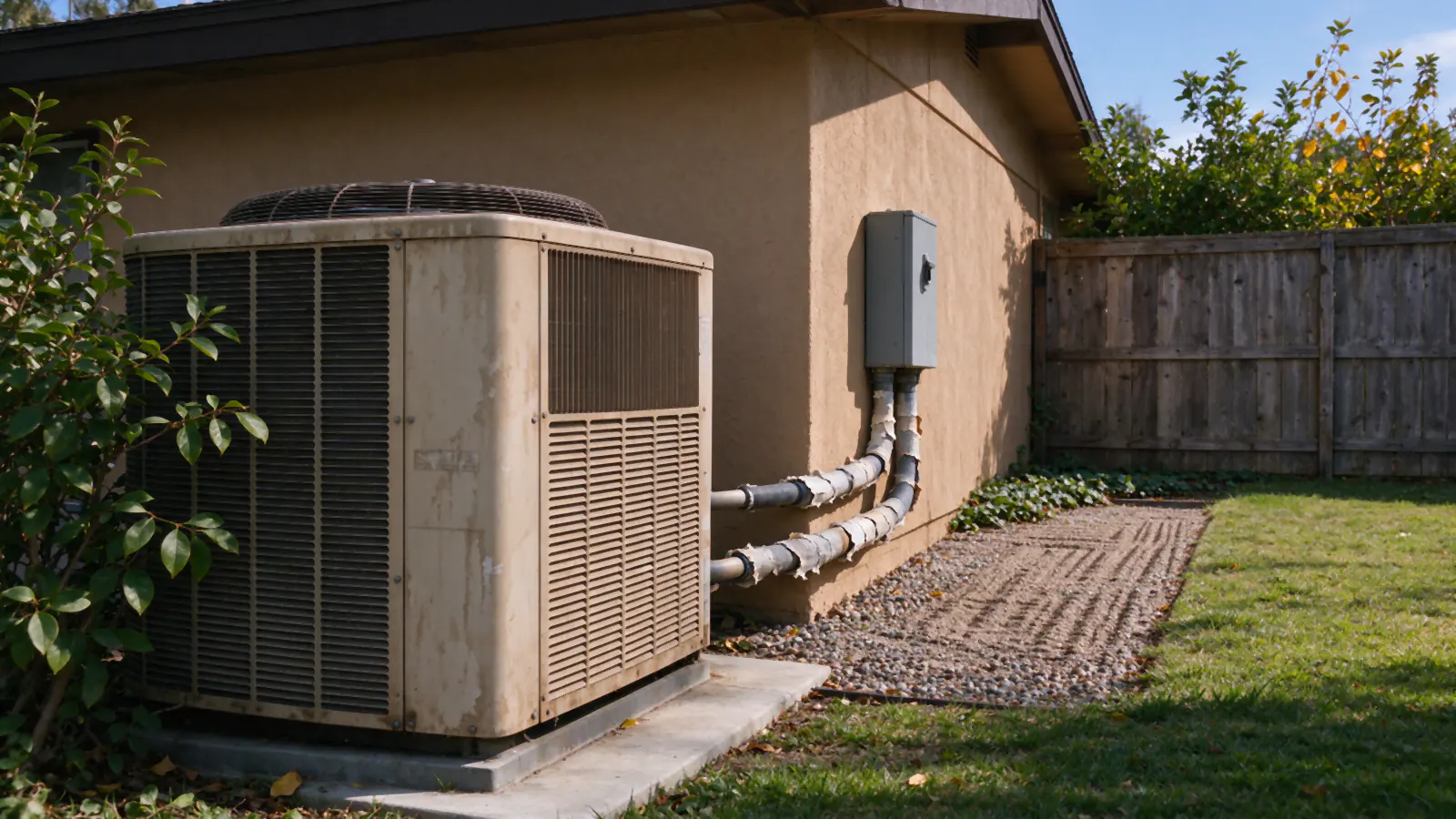
A coil packed with cottonwood fluff, grass clippings or dust, shrubs grown in around the unit, sprinklers soaking it, a dryer vent blowing lint at it, or a pad that has settled out of level all add strain. The placement guide covers what a good location needs.
What wears and what lasts
| Part | How it typically ages | When it fails |
|---|---|---|
| Capacitors and contactor | Wear items, stressed by heat and frequent starts | Usually a repair, not a reason to replace |
| Fan motors | Bearings wear with hours | Replaceable |
| Compressor | The core of the system; protected by correct charge, airflow and clean lines | Often the point where replacement is weighed |
| Coils | Can leak with age or damage | A coil leak in an older system shifts the decision |
| Reversing valve | Cycles with every season change and defrost | A costly repair |
| Ducts, line set, pad | Often outlast the equipment | Tested and reused where sound |
Repair or replace
There is no age at which replacement becomes automatic. The decision weighs the cost of the repair against the condition of the rest of the system.
Signs a repair still makes sense
A fixable fault in an otherwise sound system: a failed capacitor, a contactor, a fan motor, a small accessible leak. Heat pump repair covers how diagnosis works.
Signs replacement deserves a look
- the compressor has failed, or a coil is leaking in an older system
- the system needs refrigerant added repeatedly
- the house has never been comfortable, pointing to sizing or duct problems a repair cannot fix
- the system uses R-410A and faces a major refrigerant repair, covered in the R-454B guide
- backup strips run often and winter bills keep climbing
What replacement costs
SMUD’s published median for electric-to-heat-pump upgrade projects is about $17,000 for split systems and about $19,000 for package units, before rebates, with individual projects ranging widely. SMUD pays $1,000 when a qualifying two-stage or variable-stage system replaces an older electric system, installed by a participating contractor in the SMUD Contractor Network. The replacement cost guide breaks down the drivers.
Replacing one heat pump with another
Swapping one heat pump for another has its own standard permit wording in the City. Its permit records for the twelve months to October 25, 2026 include 337 heat pump permits written with the standard text for replacing one heat pump with another. A replacement is the chance to correct what shortened the old system’s life: a new load calculation, a duct test and sealing, a matched indoor unit for the new refrigerant and a commissioned charge and airflow.
Keeping a new system going
- change or clean the filter on schedule, and after any wildfire smoke event, as the wildfire smoke guide explains
- keep plants, fences and stored items clear of the outdoor unit
- keep the condensate drain clear, especially in summer
- have airflow, charge, electrical parts and defrost operation checked periodically
Heat pump maintenance covers a yearly check, and heat pump replacement covers the full replacement scope. To have an older system looked at or replaced, call (916) 516-1454 or request an estimate.