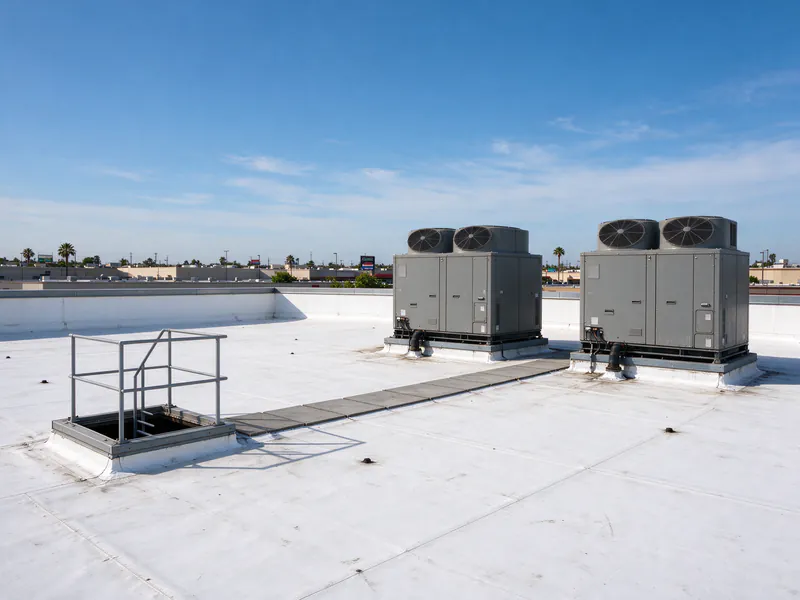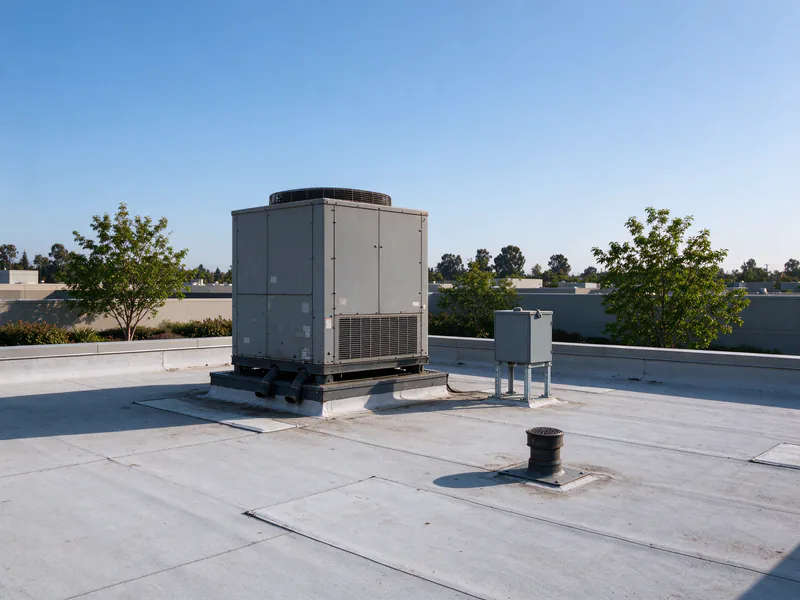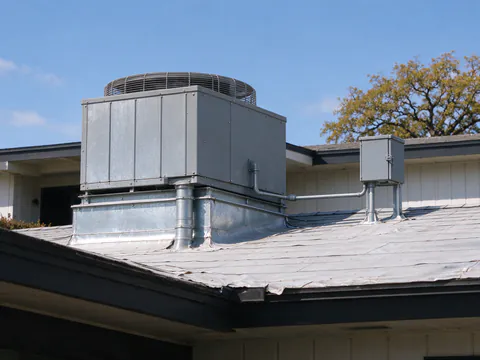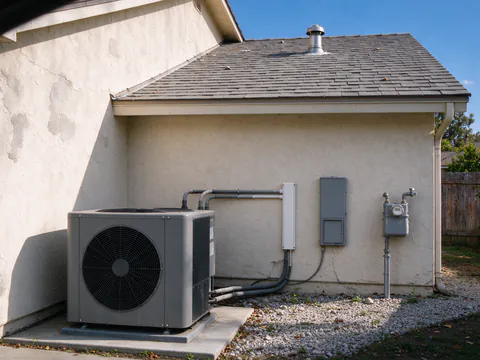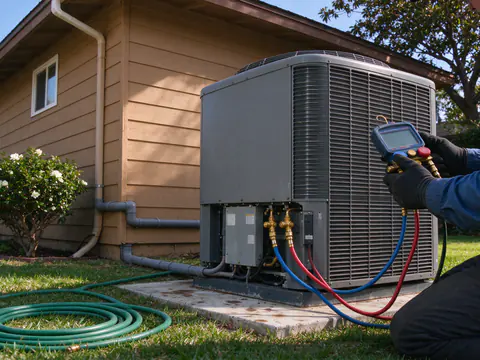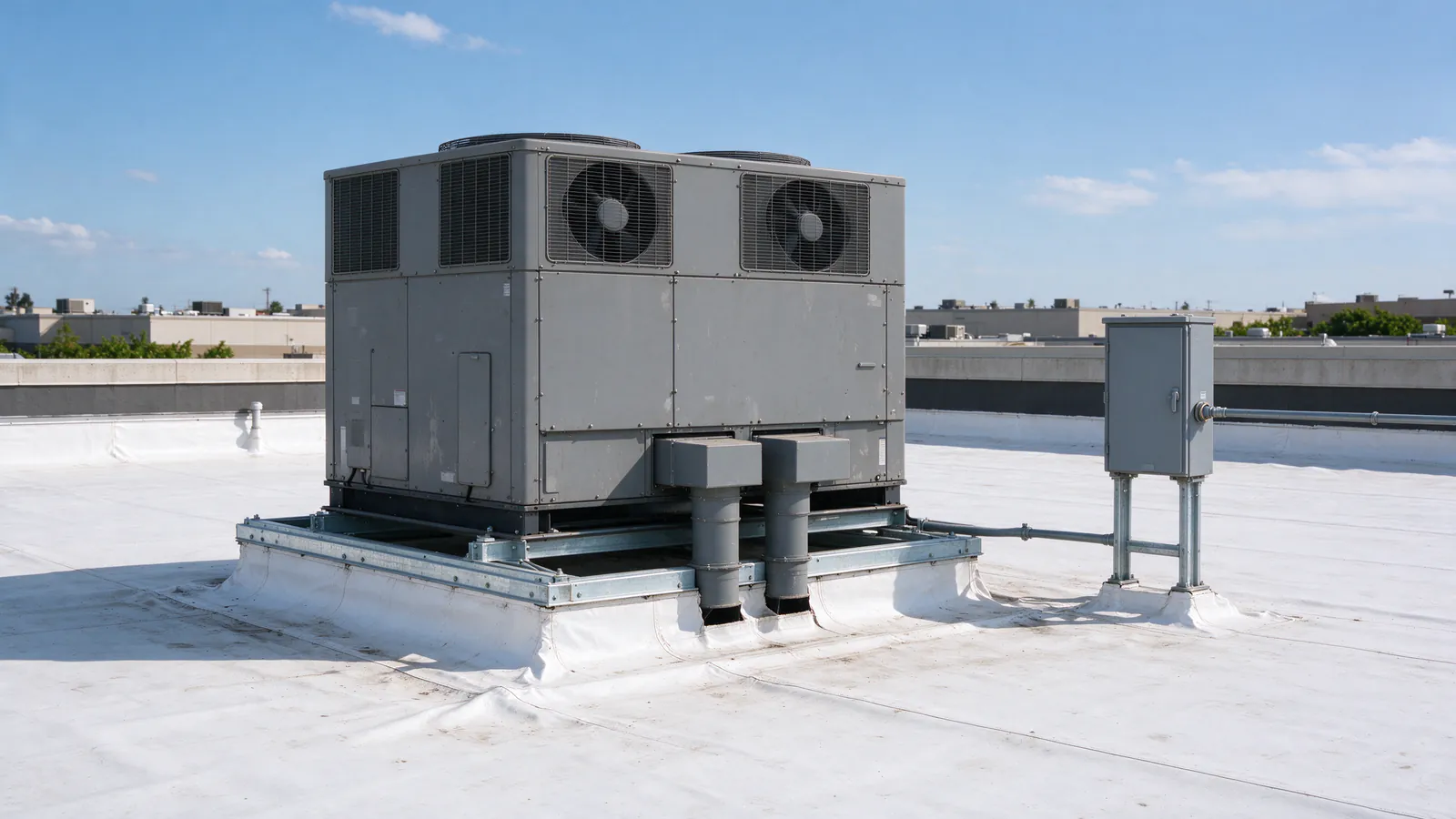
Tule Sacramento Heat Pump installs light commercial heat pumps across Sacramento County, south Placer County, east Yolo County and El Dorado Hills, with the work carried out by licensed and insured contractors. The scope is small buildings: packaged rooftop units and ground-mounted package or split heat pumps of the size found on offices, shops, small clinics and similar spaces. Central plants, chillers and engineered multi-zone systems are outside it.
What light commercial means on this page
Light commercial equipment sits between a house system and a building plant. It is usually a single packaged unit, or a few of them, each serving its own part of the building through ducts. A building of this size may have started with a gas pack, a rooftop unit that heats with a gas burner and cools with an air conditioner in one cabinet.
A heat pump package unit does both jobs with the same refrigeration circuit, reversing in winter. The physical swap looks similar to a gas pack replacement, but the electrical load, the controls, the condensate and the refrigerant rules differ enough that the scope is worth writing out in detail.
What happens on the first visit
The site visit collects what the quote depends on.
- The existing unit. Model plate, age, tonnage, fuel and the curb it sits on, measured, because the new unit’s footprint decides whether an adapter is needed.
- Access. Roof height, hatch or ladder access, parapets, and where a crane could set up, including parking lots, alleys and overhead lines.
- The load. How the space is used now: number of people, lighting, cooking or computer equipment, and west- or south-facing glass. A shop that became an office, or the reverse, may not need the old tonnage.
- Electrical service. The disconnect, the conductors, the breaker and the service itself, compared with what the new unit’s nameplate requires.
- Controls. The thermostat or building controls, the occupied schedule and any economizer on the current unit.
- Operations. When the space can be without conditioning, and who needs to be told.
The result is a written scope with the equipment, the lift, the curb work, any electrical changes and the permit named line by line.
Rooftop units: curbs, lifts and the roof itself
The curb
A rooftop unit sits on a curb, a raised frame that seals it to the roof and lines up its supply and return openings with the ducts below. When the new unit’s openings and outline match the old curb, the swap is direct. When they do not, a curb adapter sits between the two so the roof opening and the ducts stay in place, which avoids cutting and re-flashing the roof.
Getting the unit up
Unless the roof is low enough for other rigging, a rooftop unit goes up by crane, and the crane’s position, the reach and the weight of the unit are planned before the day. The lift can need a section of parking or street kept clear, and in some locations that takes its own permission. A weekend or early-morning lift is one of the things that changes the price.
Protecting the roof
Old and new units are moved across the roof surface, so walk paths and the area around the curb are protected. The condensate line is run to an approved drain point rather than left to spill onto the membrane, where standing water and algae shorten the roof’s life.
Sizing for a building, not a house
A commercial space carries heat that a home does not: more people at once, lighting for long hours, refrigerators, ovens or rows of computers. Those internal gains can make cooling the dominant load even on mild days, which is one reason the old unit’s tonnage is a starting clue rather than the answer.
Sacramento design conditions
The California Energy Commission’s design data puts the 1% cooling condition at 98°F for the Sacramento airport station, 100°F in Roseville and 103°F in Rocklin, with the 0.2% heating condition at 31°F at the airport. NOAA’s normals show about 14 days a year at 100°F or hotter in Sacramento and essentially no nights at 20°F or below on the valley floor. The heat pump sizing guide explains how loads are built from those figures.
Heating and defrost
Winter heating is rarely the constraint here (the hot weather guide covers the summer side), but damp, near-freezing mornings in tule fog season frost the outdoor coil and set off defrost cycles. On a rooftop, defrost water has to drain off the unit without pooling or refreezing on the roof. The defrost and backup heat guide covers how backup heat is staged during those cycles.
Electrical service and controls
Electrical capacity
A heat pump package unit often draws a cooling load close to the unit it replaces, but electric backup strips add to it. The nameplate’s minimum circuit ampacity and maximum overcurrent protection set the conductor and breaker size, and if either exceeds what is there, the electrical work goes into the quote. Some older buildings also need a service review before more electric load is added. The electrical panel guide explains how capacity is checked.
Schedules, thermostats and economizers
A commercial unit runs to an occupied schedule, and a heat pump set to swing hard each morning can bring backup heat on when it is not needed. Setback temperatures, recovery times and backup heat lockouts are set at startup. Where the unit has an economizer, which brings in outdoor air for free cooling on mild days, its dampers and sensors are checked so it does not stick open in summer heat or wildfire smoke.
Permits, Title 24 and refrigerant rules
Replacing commercial HVAC equipment takes a building permit from the city or county where the building is. Title 24 Part 6 has separate nonresidential requirements, so the forms and verifications differ from a house change-out and are confirmed per project. In the City of Sacramento, the minor-permit list covers residential HVAC for one- and two-family homes only, so commercial work is not on that list and its permit path is confirmed with the City’s Building Division per project. The permit and Title 24 guide covers the residential side in detail.
The refrigerant change
The EPA’s Technology Transitions rule limits new residential and light commercial air conditioning and heat pump systems to refrigerants with a global warming potential below 700 from January 1, 2025. New equipment therefore uses A2L refrigerants such as R-454B or R-32, which are classed as mildly flammable and come with their own handling and leak detection requirements. The refrigerant guide explains what changed.
Utilities, rates and rebates
The electric utility depends on the address. SMUD serves most of Sacramento County, Roseville Electric serves Roseville, and PG&E serves West Sacramento, Davis and Rocklin, while PG&E supplies gas throughout. Commercial rate schedules differ from residential ones, so any operating-cost comparison with the old gas pack uses the building’s own schedule. The heat pump vs gas furnace guide shows how that comparison works for homes.
SMUD’s heat pump HVAC rebate is written for homes individually metered by SMUD, so it does not cover a commercial meter. Other programs are checked per project and never assumed.
What drives the price of a commercial installation
Light commercial jobs vary too much from building to building for one price range to mean much, so the quote is built from the scope. The parts that move it most:
- Tonnage and efficiency. Larger and more efficient units cost more, though not in direct proportion; the SEER2 and HSPF2 guide explains the ratings.
- Curb adapter. Needed when the new footprint does not match the old curb.
- The lift. Crane size, setup time and any street or lot space it needs.
- Roof access. Height, hatch access and how far equipment travels across the roof.
- Electrical work. New conductors, a larger breaker or a service change.
- Controls and economizer. Replacing, rewiring or recommissioning them.
- After-hours work. Early-morning, evening or weekend scheduling.
- Title 24 requirements. Forms and any verification the nonresidential rules call for on that project.
Related resources
Owners of a house rather than a business will find the residential path on package heat pump replacement, and a building that wants to keep gas heat in reserve can look at dual fuel heat pumps. Once installed, heat pump maintenance keeps filters, coils and drains in order, and the placement and noise guide covers clearances around ground-mounted units.